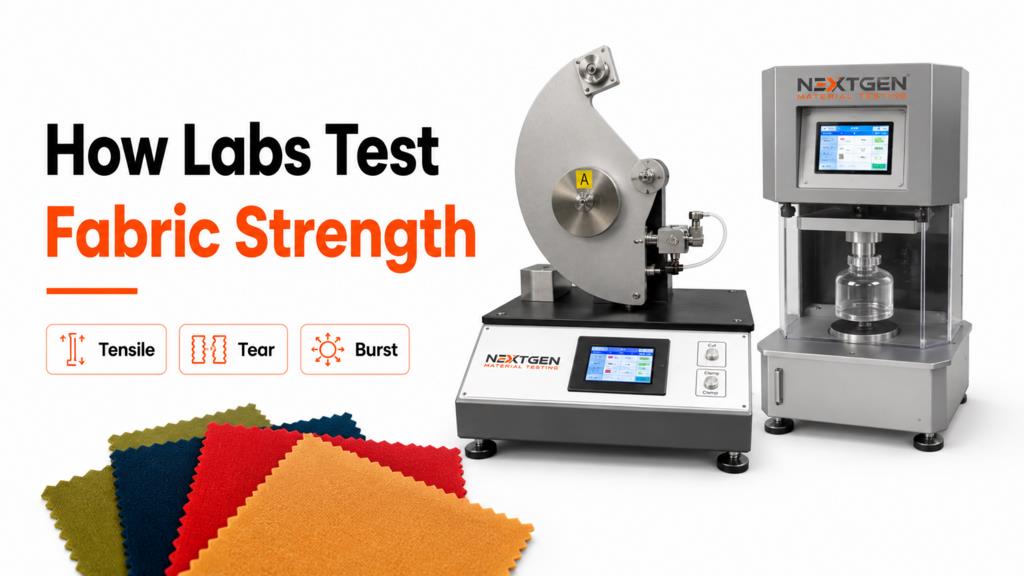
A fabric can pass an initial production review and still fail under mechanical stress. Color, weight, texture, and finish can confirm whether a fabric meets visual expectations. They do not show how the material behaves when it is pulled, torn, pressed, stitched, or handled repeatedly.
That is why fabric approval rarely depends on appearance alone. Before a material is approved for a finished product, textile labs test how it responds to controlled force. The results help manufacturers compare batches, review suppliers, and identify weak material before full-scale production begins.
Different products carry different risks. Apparel fabrics may need tensile and seam checks. Knitted or nonwoven materials often require burst testing. Coated and technical fabrics may need tear, puncture, and abrasion data. Many labs use textile testing equipment to move from visual review to measured performance.
The goal is not to predict every possible failure. It is to give quality teams enough evidence to approve, reject, or investigate a fabric before it enters production.
Why Visual Inspection Leaves Too Many Questions
Visual inspection can catch obvious production flaws, including stains, holes, shade variation, loose yarns, and visible finishing defects. It cannot measure breaking force, elongation, tear growth, or pressure resistance.
Fabric strength depends on more than surface appearance. Yarn structure, fiber content, weave, knit, coating, finishing, thickness, and material direction can all change strength, stretch, tear behavior, and long-term durability. A small shift in construction or finishing can affect how the fabric tears, stretches, or ruptures under pressure.
Direction matters as well. Many woven fabrics behave differently in the warp and weft directions, so labs often test specimens from both orientations. A material may hold well one way and fail sooner the other way. Knitted and nonwoven materials can behave differently again, since they may stretch or deform before they break.
Mechanical testing turns those hidden differences into numbers that can be compared across batches, suppliers, and material constructions. Strength tests can compare one supplier with another. They can also show whether a new batch matches earlier production. In some cases, the results help explain a field problem that was not visible during inspection.
Fabric strength testing is often part of a wider quality control process. Labs may also check abrasion, pilling, colorfastness, dimensional stability, seam behavior, and shrinkage after washing. Strength data is only one part of the picture, but it is often one of the first signs of whether a material can survive its intended use.
Different Strength Tests Measure Different Fabric Risks
There is no single fabric strength test that answers every question. Each method looks at a different type of stress. The right choice depends on the fabric structure, product use, and the type of stress the material is expected to face.
A tensile test measures how a fabric behaves under pulling force. It can show breaking force and elongation before rupture. This is useful when a material may be stretched during use, sewing, handling, or installation.
Tear testing asks a different question. It looks at what happens after a cut or small rip begins. A fabric may resist pulling force but still allow a tear to spread quickly. For that reason, labs may use an Elmendorf tearing tester to measure the force needed to continue a tear from a starter cut.
Burst testing is different again. Instead of pulling the fabric in one direction, the test applies pressure across a clamped area. This creates a more multidirectional stress pattern, which can be useful for knitted fabrics, nonwovens, coated materials, filtration media, and flexible sheet products.
Common strength checks may include:
- Tensile testing for breaking force and elongation
- Tear testing for rip growth after a starter cut
- Burst testing for rupture under pressure
- Seam testing for stitched or bonded areas
- Puncture testing for localized force
These tests often work together because most products face more than one type of stress. A sewn garment may need tensile and seam data, while a protective or technical textile may also need burst, tear, or puncture results.
Fabric failure is rarely one simple event. It can begin at a seam, a cut edge, a weak yarn, a coating flaw, or a stressed area. Lab testing helps separate those risks before the material reaches production.
Standards Make Lab Results Easier To Compare
Textile testing depends on consistent methods. Without a common method, two labs can test the same fabric and report results that are hard to compare. One lab may use a different specimen size. Another may use a different grip, speed, pressure, or conditioning process.
Standards make those choices less arbitrary. ASTM, ISO, EN, DIN, and customer methods set rules for specimen preparation, test direction, clamping, speed, conditioning, and reporting. These details matter because small setup differences can change the reported result.
For example, ASTM D5035 addresses breaking force and elongation through strip methods. ASTM D1424 covers Elmendorf-type tear testing from a starter cut. ASTM D3786 describes bursting strength testing with a diaphragm system.
Conditioning is another practical step. Textile materials respond to moisture and temperature. Some fibers absorb moisture from the air, which can affect strength, stretch, and weight. Labs often condition samples before testing so results begin from a more stable baseline.
This is one reason standards are useful in supplier approval and batch comparison. They do not make every lab result identical. They give buyers, suppliers, and laboratories a shared method for comparison. That matters when several parties need to review the same material.
Standards also help quality teams track changes over time. If a fabric fails a later test, the team can compare it with earlier results from the same method and see whether the material has shifted.
What Better Fabric Data Changes Before Launch
Fabric testing does not replace product trials or field feedback. It cannot account for every user, climate, wash cycle, or handling condition. Still, it gives manufacturers measurable evidence before a material becomes part of a finished product.
Strength data can show whether a supplier batch is drifting from earlier production. It can reveal whether a construction change affected tear resistance. It can also help teams decide whether a fabric is ready for production or needs more review.
Weak material is easier to address before cutting, sewing, coating, shipping, or assembly. Once the fabric becomes a finished product, a missed problem can lead to rework, returns, delayed shipments, or rejected lots.
For manufacturers, textile lab testing makes approval decisions easier to defend. The fabric may still need judgment from designers, engineers, and quality teams. Those decisions are easier to make when the data is clear.
FAQs
Why Do Textile Labs Test Fabric Strength Before Production?
Textile labs test fabric strength to see how a material behaves under force. A fabric may look acceptable during inspection but still tear, stretch, burst, or fail at the seam. Testing gives manufacturers measured data before the fabric moves into full production.
What Is Fabric Strength Testing?
Fabric strength testing measures how a textile responds to stress. Labs may test pulling force, tear resistance, bursting pressure, seam strength, or puncture resistance. The method depends on the fabric type and how the finished product will be used.
Is Visual Inspection Enough For Fabric Quality Control?
Visual inspection is useful, but it is not enough on its own. It can find stains, holes, shade issues, and visible defects. It cannot show how much force the fabric can handle or how it may fail during use.
What Is The Difference Between Tensile Testing And Tear Testing?
Tensile testing measures how a fabric performs when pulled until it stretches or breaks. Tear testing measures how easily a rip continues after a cut has already started. Both tests measure strength, but they look at different failure risks.
When Is Burst Testing Used For Fabrics?
Burst testing is often used for knitted fabrics, nonwovens, coated textiles, filtration media, and flexible materials. It applies pressure across an area instead of pulling the fabric in one direction. This makes it useful for materials that stretch or deform under pressure.
Why Do Textile Testing Standards Matter?
Standards give labs a shared way to prepare samples, condition fabric, set test speed, hold specimens, and report results. This makes results easier to compare across suppliers, batches, and testing locations.
Can Fabric Strength Testing Prevent Product Failures?
Fabric strength testing cannot predict every real-world problem. It can, however, help manufacturers find weak batches, compare suppliers, and review material changes before production. That makes approval decisions more reliable.