Key Takeaways
- Emerald ash borer damage can be difficult to see during the early stages.
- Not every ash tree requires removal, but not every tree is a sound treatment candidate.
- A tree’s health, structure, location, canopy loss, and long-term landscape value should guide the decision.
- Repeated treatment may help protect selected ash trees with low to moderate infestation.
- Dead, brittle, severely declining, or structurally compromised ash trees may need prompt removal before they become hazardous.
- Certified arborist evaluations connect pest symptoms with practical property-risk planning.
For homeowners, property managers, and neighborhood associations in Milwaukee, WI, an ash tree can represent decades of shade, curb appeal, and summer relief. When the emerald ash borer becomes a concern, the choice is rarely as simple as “treat it” or “cut it down.” A professional evaluation by certified arborists in the Greater Milwaukee area can help determine whether an ash tree is still a strong candidate for protection, needs close monitoring, or has become a safety concern. That decision matters throughout Greater Milwaukee, where mature trees often grow close to homes, garages, sidewalks, alleys, driveways, and utility lines. Milwaukee’s freeze-thaw cycles, road-salt exposure, compacted city soils, summer dry spells, and stormy spring weather can all add stress to an ash tree already facing an invasive pest.
Why Is Emerald Ash Borer Such a Serious Milwaukee Concern?
Emerald ash borer, often called EAB, is an invasive beetle whose larvae feed beneath the bark of ash trees. That feeding damages the tissues that move water and nutrients through the tree. Because the activity is hidden under bark, an ash can look relatively normal while decline is already underway. The USDA APHIS emerald ash borer overview explains that the pest has caused the death and decline of tens of millions of ash trees in North America.
In Milwaukee neighborhoods, the concern is not only the loss of a valued tree. As ash trees decline, upper limbs can become brittle, bark may loosen, and the risk around patios, parked cars, walkways, and neighboring properties can increase. A once-healthy boulevard tree or backyard shade tree may therefore become both a plant-health issue and a safety issue.
What Signs Should Property Owners Watch For?
One symptom alone does not confirm emerald ash borer. Drought, root damage, storm injury, disease, and insect damage can cause similar signs. Still, an inspection is warranted when a true ash tree shows one or more of the following:
- Thinning leaves or an uneven canopy, especially near the upper crown.
- Dead branches high in the tree.
- Vertical bark cracks or sections of peeling bark.
- New shoots growing along the trunk or around the base.
- D-shaped exit holes left by emerging adult beetles.
- S-shaped galleries beneath the removed bark.
- Unusually heavy woodpecker activity or pale bark flecking.
- Large limbs that appear weak, dead, or detached from the canopy.
Why Does a Certified Arborist Assessment Matter?
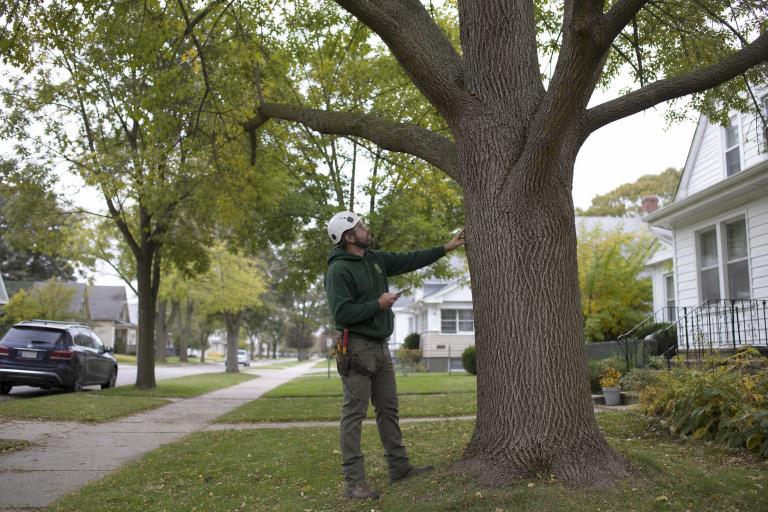
Tree work and arborist-led tree assessment are not the same thing. A proper evaluation looks beyond visible insects or dead branches. It considers whether the tree is actually an ash, how much live canopy remains, whether there are cracks or cavities, how close the tree is to potential targets, and whether treatment would be a reasonable long-term investment. An arborist may also assess branch structure, root condition, previous storm damage, soil conditions, and signs of decay that are not immediately obvious from the ground. These factors help determine whether a tree can remain safely with ongoing care or whether its condition presents an unacceptable level of risk.
For example, a large ash in a Milwaukee backyard may still have significant shade value, solid structure, and only limited decline. That tree may justify a protection plan that includes treatment, regular monitoring, and selective pruning. Another ash of the same size may be leaning over a garage, losing major limbs, and showing extensive canopy dieback. Even if treatment is technically feasible, removal may be the more responsible choice given the increased likelihood of structural failure. Every tree should be evaluated individually rather than relying on size, age, or visible symptoms alone, allowing homeowners to make informed decisions that balance safety, cost, and the long-term value of the landscape.
When Is Treatment Worth Considering?
Treatment may be worth discussing when an ash tree remains healthy or only lightly to moderately affected, has good structural integrity, and provides meaningful value through shade, screening, energy savings, or neighborhood character. Treatment should be viewed as ongoing management, not a one-time cure. Product selection, application timing, tree size, pest pressure, and follow-up needs all affect the plan. The Wisconsin DNR’s emerald ash borer guidance notes that insecticide treatment can protect individual urban and residential ash trees and can be effective for trees with low to moderate infestation. It also stresses that repeated applications are typically needed for the life of a treated tree.
Factors That Often Support Treatment
- The tree retains a reasonably full canopy and shows good vigor.
- Its trunk and major limbs have no serious structural defects.
- The tree is important to the property’s shade, appearance, or privacy.
- There is room to maintain the tree over time safely.
- The owner is prepared for scheduled monitoring and repeat applications.
When Is Removal the Safer Path?
Removal is not a failure. In many Greater Milwaukee settings, it is the prudent solution for an ash that is dead, severely declining, heavily infested, structurally weak, or positioned above an area with frequent activity. Waiting until an ash dies completely can make removal more difficult because Emerald Ash Borer-killed trees often become increasingly brittle, making limbs and trunk sections less predictable during removal. Delaying the decision may also increase the risk of unexpected branch failure during storms or periods of high wind. Consider removal planning when an ash has substantial upper-canopy loss, major deadwood, split leaders, severe decay, unstable roots, or limbs hanging over a roof, street, play area, driveway, or parking space. Trees that threaten neighboring properties or utility corridors may also require prompt attention. Professional removal is particularly important on dense city lots where access is limited, and nearby homes, garages, fences, and landscaping leave little room for error. Experienced crews can evaluate the safest removal method, determine whether specialized equipment such as cranes or rigging systems is needed, and complete the work while minimizing the risk of damage to surrounding property. Planning removal before the tree reaches an advanced stage of decline can also improve safety, reduce project complexity, and provide more flexibility in scheduling the work.
How Do Local Milwaukee Conditions Change the Decision?
Greater Milwaukee properties are not all alike. An ash near Lake Michigan may experience different wind and moisture patterns than one in a dense West Allis neighborhood or on a larger lot in Mequon, Brookfield, Menomonee Falls, Wauwatosa, Shorewood, Whitefish Bay, or Germantown. Road salt can stress trees near curbs and sidewalks. Soil compaction can limit roots. Construction can damage the root zone long before symptoms become visible.
These conditions do not automatically mean the emerald ash borer is present. They do mean that an ash tree may have less reserve capacity to handle pest injury. A complete recommendation may include plant health care, selective pruning, structural support, removal, and replacement planting rather than a single service.
How Should You Prepare for an Ash Tree Consultation?
- Take photos of the full tree, canopy, trunk, and any suspicious bark damage.
- Make note of prior treatments, pruning, storm damage, or nearby construction.
- Identify what sits beneath the canopy, including roofs, vehicles, sidewalks, and utility lines.
- Think about your priority: preservation, safety, removal, or replacement.
- Ask how often treatment would be needed, what results are realistic, and what risks remain.
Local Help for Ash Tree Decisions in Milwaukee, WI
Location: Crawford Tree & Landscape Services, Inc. | 8760 W Calumet Rd, Milwaukee, WI 53224 | (414) 710-0093
Whether an ash tree needs protection, monitoring, pruning, risk assessment, removal, or a replacement strategy, an informed inspection can prevent rushed decisions. For Milwaukee-area property owners, acting before severe decline can preserve options, improve safety, and support a healthier, more resilient urban canopy.
Frequently Asked Questions
Can an arborist confirm whether my tree has emerald ash borer?
An arborist can inspect the tree for common EAB symptoms, confirm whether it is an ash, evaluate canopy health and structure, and distinguish likely pest damage from other stresses. Some confirmation may require closer examination because early damage is often hidden beneath the bark.
Can a declining ash tree still be treated?
Possibly. Trees with limited to moderate decline and sound structure may still be candidates for treatment. A severely declining tree with extensive canopy loss, major defects, or high property risk may be better suited for removal.
Should a dead ash tree be removed quickly?
Dead ash trees should be evaluated promptly. As the wood becomes brittle, the risk of limbs falling and of removal challenges increases, especially when the tree is close to buildings, sidewalks, vehicles, or neighboring properties.
Conclusion
Emerald ash borer decisions are most effective when made before severe decline limits available options. Early inspections, accurate identification, and a professional assessment of the tree’s health, structure, and location can help determine whether treatment, continued monitoring, or removal is the most practical course of action. While some ash trees can remain valuable with ongoing care, others may present increasing safety risks as infestation progresses. By responding promptly to warning signs and working with a certified arborist, Milwaukee property owners can protect people, preserve healthy trees where appropriate, and make informed long-term decisions that support both property safety and the resilience of the local urban forest.