Choosing timber flooring isn’t only about finding the right colour or type of wood. The direction and pattern of the boards can change the way you perceive an entire room. The same timber laid in three different patterns can produce three surprisingly different results.
Straight boards tend to create a clean, understated look, while chevron and herringbone introduce more movement and visual detail. Options such as herringbone french oak floors can even make the flooring itself a prominent design feature rather than simply the surface underneath your furniture. The trick is deciding how much attention you actually want your floor to attract.
Before choosing a pattern from a showroom display or photograph, consider the size and shape of your room, your furniture and the overall style you’re trying to create.
Straight Boards Keep Things Simple
Straight-laid boards are probably what most people picture when they think about timber flooring.
The boards run alongside one another in the same direction, allowing the grain, colour and natural variation of the timber to do most of the visual work.
This simplicity makes straight flooring incredibly versatile. It can work with traditional interiors, minimalist spaces and almost everything in between.
Board direction also influences how the room feels. Running boards along the longest dimension of a room can emphasise its length, while other orientations may draw your eye towards a particular architectural feature.
For open-plan spaces, straight boards can also provide visual continuity without making the floor overly dominant.
Herringbone Adds Movement
Herringbone creates its distinctive appearance by arranging rectangular boards in a repeating zigzag pattern.
Because the individual pieces change direction, your eye naturally follows the pattern across the room. That gives the floor considerably more visual movement than a traditional straight layout.
Herringbone can work particularly well when you want the floor to become part of the room’s design rather than disappear into the background.
However, it’s worth considering everything else happening in the space. Highly detailed cabinetry, bold furniture, patterned rugs and a visually active floor can start competing with one another.
If you’re choosing a prominent flooring pattern, you may prefer to let some other elements of the room remain relatively simple.
Chevron Creates a Cleaner Zigzag
Chevron and herringbone are sometimes confused, but they aren’t the same pattern.
In a chevron layout, the ends of the boards are cut at angles so they meet to create continuous V shapes. Herringbone generally uses rectangular pieces that meet in an overlapping arrangement.
That difference gives chevron a more continuous, directional appearance.
It can draw your eye strongly through a room, which makes orientation particularly important. Think about what the pattern will point towards when you enter the space. A carefully positioned layout might lead your eye towards a fireplace, large window or another feature you want to emphasise.
Room Size Matters — But There Are No Absolute Rules
You may hear that patterned flooring should only be used in large rooms. That’s too simplistic.
Herringbone or chevron can work beautifully in smaller spaces. The more important question is how the scale of the pattern relates to the room.
Board dimensions, colour variation and surrounding furniture all influence how busy the finished floor appears.
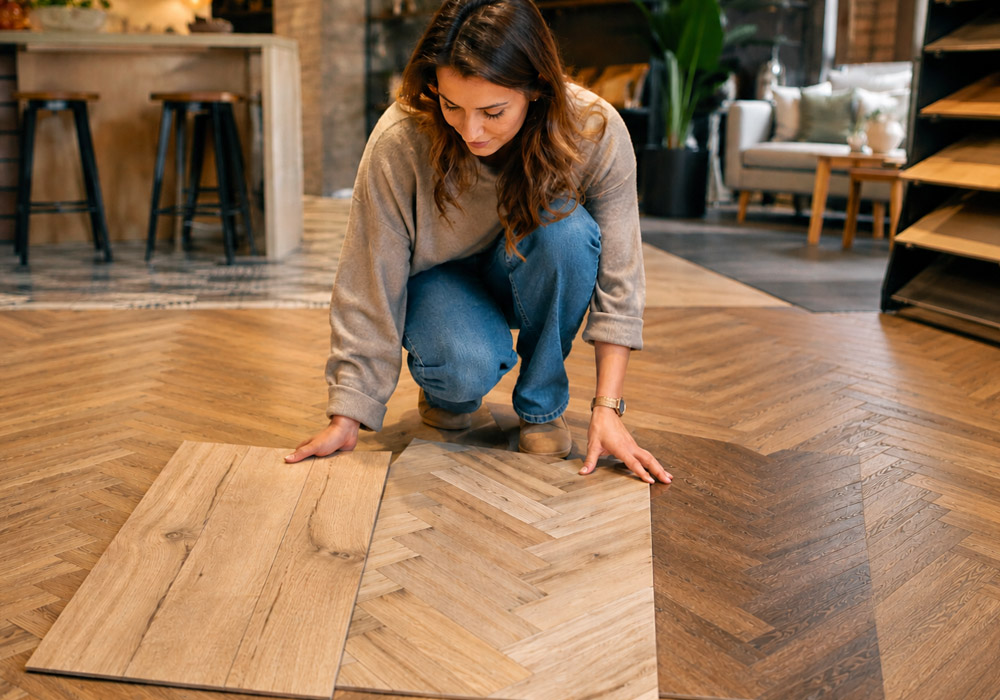
A useful approach is to see a larger sample rather than making your decision from two or three pieces of timber. If possible, view photographs of the exact product installed across an entire room.
A pattern that looks subtle on a small sample can become much more prominent across several hundred square feet.
Think About Where the Pattern Begins
Patterned floors require more planning than simply choosing the timber.
The installer needs to consider the room’s dimensions, focal points, doorways and how the pattern will continue into adjoining areas.
Small positioning changes can influence the symmetry of the finished floor, particularly in highly visible spaces.
If you’re flooring multiple connected rooms, discuss how transitions will work before installation begins. You don’t want to make those decisions after half the floor is already down.
Professional installation can be especially valuable with more complex patterns because alignment errors tend to be much easier to notice.
Don’t Forget About Furniture
The empty room isn’t the room you’ll actually live in.
A beautiful pattern may look impressive when nothing is covering it, but eventually you’ll add sofas, tables, rugs, beds and storage.
Before committing, roughly map out where your major furniture will sit. Consider which sections of flooring will remain visible and whether the pattern complements the way the room is arranged.
This can also help you decide whether paying for a more intricate installation across the entire space makes sense for your priorities.
Let the Room Guide the Pattern
There’s no universally superior way to lay timber flooring.
Straight boards are versatile and allow the timber itself to take centre stage. Herringbone brings texture and movement. Chevron creates strong, clean lines that can direct the eye through a space.
The right choice depends on what else is happening in the room.
Bring samples home, look at large-scale examples and think about furniture before deciding. Most importantly, don’t choose a pattern simply because it’s currently popular.
A floor occupies an enormous amount of visual space and may remain in your home for decades. Choose the pattern that makes sense not only in a beautifully styled photograph, but in the room you’ll actually live in every day.