
Core Legal Elements: Establishing Liability and Fault
If you’ve recently been injured due to someone else’s negligence, the road ahead can feel incredibly overwhelming. Beyond the physical recovery, dealing with insurance companies, gathering evidence, and understanding legal procedures can feel like a daunting maze. We understand these challenges.
This comprehensive guide is designed to demystify the journey of navigating personal injury claims. We will walk you through every critical stage, from the moments right after an accident to the final settlement or verdict. Understanding each step is vital to protecting your rights and securing the compensation you deserve in October 2026.
We believe that with the right information and dedicated personal injury support, you can confidently navigate this complex process. Join us as we explore the essential actions, legal elements, and strategic decisions involved in a personal injury claim, ensuring you are well-prepared for what lies ahead.

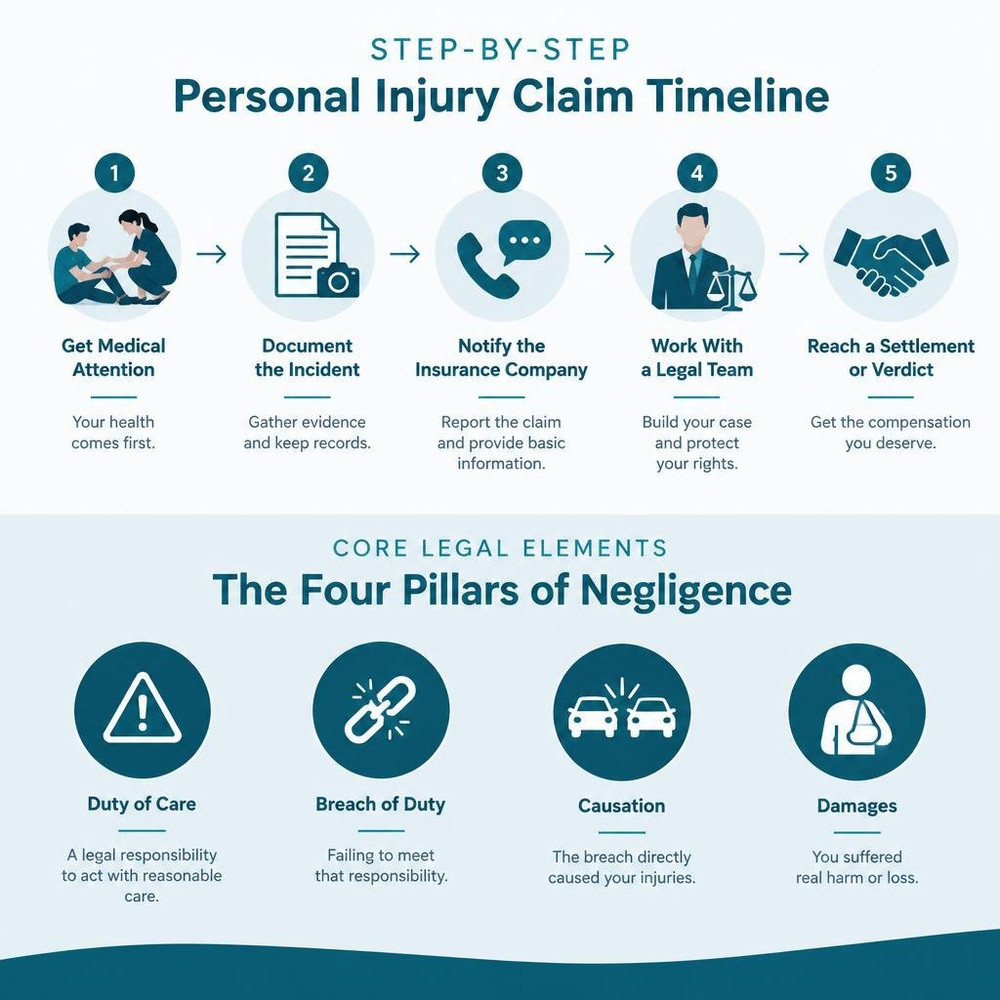
Successfully navigating personal injury claims hinges on proving that another party’s negligence directly caused your injuries. This involves establishing several core legal elements that form the foundation of any claim. Without a clear understanding of these principles, it can be challenging to build a compelling case. When facing complex liability issues, consulting with experienced accident negligence attorneys can provide invaluable guidance and strategic direction.
The Four Pillars of Negligence
At the heart of most personal injury claims lies the concept of negligence, which requires proving four essential elements:
- Duty of Care: The responsible party must have owed you a legal duty to act with reasonable care. For instance, drivers owe other motorists and pedestrians a duty to operate their vehicles safely. Property owners have a duty to maintain safe premises for visitors.
- Breach of Duty: This duty must have been violated. The responsible party failed to act as a reasonably prudent person would have under similar circumstances. This could be speeding, ignoring a stop sign, failing to clean a spill, or neglecting necessary maintenance.
- Causation: The breach of duty must have directly caused your injuries. There are two aspects to causation:
- Cause-in-fact: Your injury would not have occurred “but for” the defendant’s negligent act.
- Proximate cause: The injury was a foreseeable result of the defendant’s negligence. The connection between the breach and the injury cannot be too remote or indirect.
- Damages: You must have suffered actual, quantifiable harm or losses as a result of the injury. These can include medical expenses, lost wages, pain and suffering, and other financial or non-financial impacts.
The burden of proof rests on the injured party to demonstrate each of these elements by a preponderance of the evidence, meaning it is more likely than not that the defendant was negligent and caused the harm.
Shared Fault and Comparative Negligence Rules
It’s not uncommon for accident victims to worry if their own actions contributed to the incident. The good news is that in many jurisdictions, being partially at fault doesn’t automatically bar you from recovering damages. This is where rules regarding shared fault, such as comparative negligence, come into play.
Most states follow either a system of comparative negligence or, less commonly, contributory negligence:
- Contributory Negligence: In a few states, if you are found to be even 1% at fault for the accident, you are completely barred from recovering any damages. This is a very strict rule and is increasingly rare.
- Comparative Negligence: Most states use some form of comparative negligence. This system allows injured parties to recover damages even if they were partially at fault, but their compensation is reduced proportionally to their degree of fault. There are two main types:
- Pure Comparative Negligence: You can recover damages even if you are 99% at fault, though your award will be reduced by your percentage of fault.
- Modified Comparative Fault: You can recover damages as long as your fault does not exceed a certain threshold (typically 50% or 51%). If your fault meets or exceeds that threshold, you cannot recover anything. If it’s below the threshold, your damages are reduced by your percentage of fault.
Understanding how liability allocation works in your state is crucial, as it directly impacts the potential value of your claim. For instance, if your total damages are $100,000 and you are found 20% at fault under a modified comparative fault rule (with a 51% threshold), you would only be able to recover $80,000.
Essential Steps in Navigating Personal Injury Claims
Once liability is established, the practical steps of navigating personal injury claims begin. This phase focuses on statutory compliance, thorough pre-suit investigation, identifying all responsible parties, notifying insurers, and meticulously preserving your claim. Timely action and organized documentation are paramount here.
Evidence Preservation: Critical Actions in Navigating Personal Injury Claims
The moments immediately following an accident are critical for evidence preservation. What you do or don’t do in these initial hours and days can significantly impact the strength of your personal injury claim.
- Scene Photography: If safe to do so, take numerous photos and videos of the accident scene from various angles. Capture vehicle damage, road conditions, traffic signs, skid marks, debris, and any environmental factors.
- Surveillance Footage: Many businesses, traffic intersections, and even private homes have surveillance cameras. Requesting this footage promptly is vital, as many systems overwrite recordings within 48-72 hours.
- Witness Statements: Obtain contact information for any witnesses. Even a brief, written statement at the scene can be incredibly valuable.
- Chain of Custody: For any physical evidence, maintaining a clear chain of custody ensures its integrity and admissibility. Document who collected what, when, and where it is stored.


Here’s a list of essential perishable evidence to collect immediately:
- Photographs/Videos: Of the scene, vehicles, injuries, and any contributing factors.
- Witness Contact Information: Names, phone numbers, and email addresses.
- Police or Incident Reports: Official documentation of the event.
- Dashcam or Bodycam Footage: If available from any vehicles or individuals involved.
- Business Surveillance Footage: Especially for slip-and-fall or premises liability cases.
- Text Messages or Digital Communications: Relevant to the incident or injuries.
- Physical Evidence from the Scene: Such as vehicle parts, clothing, or defective products (if safe to collect and preserve properly).
Documenting Medical Care and Damages
Your medical records are the backbone of your personal injury claim. They provide objective evidence of your injuries, the treatment you received, and the impact the injuries have had on your life.
- Consistent Treatment: Seek immediate medical attention after an accident, even if you feel fine. Some injuries, like whiplash or concussions, may not present symptoms for hours or days. Follow all medical advice, attend all appointments, and complete all prescribed therapies. Gaps in treatment can be used by insurance companies to argue that your injuries are not severe or are unrelated to the accident.
- Diagnostic Imaging: X-rays, MRIs, CT scans, and other diagnostic tests provide concrete evidence of internal injuries. Ensure all recommended imaging is completed and the results are documented.
- Pain Journal: Maintain a detailed journal documenting your pain levels, symptoms, limitations, and how your injuries affect your daily life. Include dates, times, and specific examples. This journal helps substantiate non-economic damages like pain and suffering.
- Functional Limitations: Document any activities you can no longer perform or that are now difficult due to your injuries, such as working, hobbies, household chores, or caring for family. This helps illustrate the full scope of your damages.
Formulating the Demand Package and Settlement Strategy
Once your medical treatment is substantially complete, and you have a clear understanding of your prognosis, you can begin to formulate your demand package. This is a comprehensive document sent to the at-fault party’s insurance company, outlining your claim and demanding a specific settlement amount.
A strong demand letter typically includes:
- Factual Summary: A clear, concise narrative of how the accident occurred and how the other party’s negligence caused it.
- Damages Chronology: A detailed timeline of your medical treatment, including all bills, lost wages, and other economic losses.
- Liability Evidence: References to police reports, witness statements, and other evidence supporting the at-fault party’s negligence.
- Pain and Suffering Narrative: A compelling description of your non-economic damages, often supported by your pain journal.
- Settlement Demand: A specific monetary amount you are seeking to resolve the claim.
Crafting an effective demand package requires careful attention to detail and a strategic approach to valuation. For complex cases or when you need assistance in accurately assessing your settlement range, seeking dedicated personal injury support can be highly beneficial. They can help ensure your demand is well-supported and maximizes your potential recovery.
The Claims Lifecycle: From Settlement Negotiations to Formal Litigation
After submitting your demand package, the personal injury claim transitions into a phase of negotiation, and potentially, formal litigation. Understanding the distinction between a “claim” and a “lawsuit,” along with the tactics employed by insurance adjusters and the various procedural stages, is crucial.
Insurance Tactics and Adjuster Communications
Insurance adjusters are trained professionals whose primary goal is to minimize the payout on claims. While some are fair, many employ tactics designed to reduce your settlement or deny your claim altogether.
Common adjuster strategies include:
- Early Lowball Offers: Adjusters may offer a quick, low settlement, especially if they know you are in financial distress. These offers rarely reflect the true value of your claim.
- Requests for Recorded Statements: They may ask you to give a recorded statement. While you must cooperate with your own insurance company, you are generally not obligated to give a recorded statement to the at-fault party’s insurer without legal counsel. Anything you say can be used against you.
- Broad Medical Authorizations: Adjusters might ask you to sign a blanket medical authorization, which could allow them access to your entire medical history, potentially uncovering pre-existing conditions they can use to dispute your claim. It’s often better to provide specific medical records relevant to the accident.
- Delaying Tactics: They may intentionally delay the process, hoping you will become frustrated and accept a lower offer.
- Disputing Liability or Damages: Adjusters may try to shift blame to you or argue that your injuries are not as severe as claimed or are not related to the accident.
It is always advisable to limit your communications with insurance adjusters to basic factual information (name, date, location of accident) and avoid discussing fault, apologizing, or giving recorded statements without first consulting an attorney. All important communications should be in writing, and you should keep copies of everything.
Procedural Stages in Navigating Personal Injury Claims
If negotiations fail to produce a fair settlement, your personal injury claim may escalate into a formal lawsuit. This involves several distinct procedural stages:


- Complaint Filing: Your attorney files a formal complaint with the appropriate court, outlining the facts of the case, the legal basis for your claim, and the damages you are seeking. This officially initiates the lawsuit.
- Service of Process: The defendant (the at-fault party) is formally notified of the lawsuit through a process server or certified mail. They then have a limited time to respond to the complaint.
- Formal Discovery: This is a crucial information-gathering phase. Both sides exchange information through:
- Interrogatories: Written questions that must be answered under oath.
- Requests for Production of Documents: Demands for relevant documents, such as medical records, bills, employment records, and insurance policies.
- Depositions: Out-of-court, sworn testimonies taken from parties and witnesses.
- Mediation/Alternative Dispute Resolution (ADR): Many courts require or encourage mediation before trial. A neutral third-party mediator helps both sides explore settlement options. Arbitration, another form of ADR, involves a neutral arbitrator making a binding or non-binding decision.
- Trial Preparation: If mediation is unsuccessful, both sides prepare for trial. This involves selecting a jury, preparing witnesses, drafting opening and closing statements, and organizing evidence.
- Trial: The case is presented before a judge and/or jury, who will hear evidence, witness testimonies, and legal arguments before rendering a verdict.
- Appeal: If either party is dissatisfied with the trial’s outcome, they may have grounds to appeal the decision to a higher court.
Navigating these complex legal stages requires a deep understanding of civil procedure and trial advocacy. Engaging aggressive legal representation can significantly enhance your chances of success, ensuring your rights are protected at every turn.
Calculating Compensation, Resolving Liens, and Final Payouts
The ultimate goal of navigating personal injury claims is to secure fair compensation for your losses. This involves not only accurately valuing your damages but also understanding how various liens and subrogation rights can impact your final payout.
Valuing Economic vs. Non-Economic Losses
Personal injury damages are generally categorized into two main types: economic and non-economic.
- Economic Damages (Special Damages): These are quantifiable financial losses that can be precisely calculated. They include:
- Medical Expenses: Past and future medical bills, including doctor visits, hospital stays, surgeries, medications, rehabilitation, and assistive devices.
- Lost Wages/Income: Income lost due to time off work, as well as future lost earning capacity if your injuries prevent you from returning to your previous job or working at full capacity.
- Property Damage: Costs to repair or replace damaged property (e.g., vehicle).
- Out-of-Pocket Expenses: Costs for transportation to medical appointments, household help, childcare, or other services you needed due to your injuries.
- Non-Economic Damages (General Damages): These are subjective, non-monetary losses that are harder to quantify but are equally significant. They include:
- Pain and Suffering: Physical pain and discomfort caused by the injury and its treatment.
- Emotional Distress: Anxiety, depression, fear, anger, and other psychological impacts.
- Loss of Enjoyment of Life: Inability to participate in hobbies, recreational activities, or daily routines you enjoyed before the injury.
- Disfigurement/Scarring: Physical changes that impact self-esteem and quality of life.
- Loss of Consortium: Damages for the negative impact on marital relationships.
While economic damages are calculated by summing up bills and receipts, non-economic damages are often estimated using methods like the “multiplier method.” This involves multiplying the total economic damages by a factor (typically 1.5 to 5, depending on the severity and permanence of the injury) to arrive at a figure for pain and suffering.
Here’s a comparison:
| Category | Description | Examples |
|---|---|---|
| Economic | Quantifiable, objective financial losses | Medical bills, lost wages, property repair, prescription costs, rehabilitation expenses |
| Non-Economic | Subjective, non-monetary losses related to quality of life and emotional well-being | Physical pain, emotional distress, loss of companionship, disfigurement, inability to pursue hobbies |
Managing Medical Liens and Subrogation Rights
Even after a settlement or verdict, the full amount of compensation isn’t immediately yours. Various entities may have a legal right to be reimbursed from your settlement proceeds, known as liens or subrogation rights.
- Health Insurance Liens: If your private health insurance paid for your medical treatment related to the accident, they typically have a right to be reimbursed from your personal injury settlement. This is known as subrogation.
- Medicare Subrogation: If Medicare paid for your accident-related medical care, it has a federal right to recover those payments from your settlement.
- Medicaid Recovery: Similarly, state Medicaid programs have a right to recover payments made for accident-related medical treatment.
- Provider Liens: Some medical providers (e.g., hospitals, chiropractors) may treat you on a “lien basis,” meaning they agree to defer payment until your case settles, at which point they are paid directly from your settlement.
- Workers’ Compensation Liens: If your injury occurred at work and you received workers’ compensation benefits, the workers’ comp insurer will have a lien on your personal injury settlement for the benefits they paid.
Negotiating these liens is a critical part of the post-settlement process. An experienced attorney can often negotiate with lienholders to reduce the amount they are owed, maximizing the net amount you receive. Understanding these deductions upfront is essential for a realistic expectation of your final payout.
Frequently Asked Questions About Filing a Personal Injury Claim
We often encounter similar questions from individuals navigating personal injury claims. Here, we address some of the most common concerns to provide clarity and guidance.
How long do I have to file a personal injury claim?
This is one of the most critical questions, as missing the deadline can permanently bar your claim. The time limit for filing a personal injury lawsuit is known as the statute of limitations, and it varies significantly by state and the type of injury.
- State Deadlines: Most states have a statute of limitations of two or three years for general personal injury claims. For example, some states have a two-year limit, while others might allow three years from the date of the injury.
- Government Notices: Claims against government entities (e.g., a city, county, or state) often have much shorter notice requirements, sometimes as little as 60 to 90 days from the date of the injury, before a formal lawsuit can be filed.
- Tolling Exceptions: In certain circumstances, the statute of limitations can be “tolled” or paused. This might occur if the injured party is a minor, mentally incapacitated, or if the injury was not discovered until much later (the “discovery rule”). However, these exceptions are specific and not universally applicable.
Given the strict nature of these deadlines, it is imperative to consult with an attorney as soon as possible after an injury to determine the exact statute of limitations applicable to your specific case in October 2026.
Do I need to hire an attorney, or can I handle the claim myself?
Whether you need a personal injury attorney depends largely on the complexity of your case, the severity of your injuries, and whether liability is disputed.
- Self-Representation: For very minor accidents with clear liability, minimal property damage, and no significant injuries (e.g., a fender-bender with only soft tissue injuries that resolve quickly), you might be able to handle the claim yourself. In such cases, the process primarily involves collecting medical bills and negotiating with the insurance company.
- Claim Complexity & Disputed Liability: If your injuries are serious, require extensive medical treatment, involve lost wages, or result in permanent impairment, an attorney is highly recommended. Similarly, if there’s any dispute about who was at fault for the accident, navigating the claim without legal counsel can be extremely challenging.
- Severe Injuries: Cases involving catastrophic injuries, wrongful death, or multiple liable parties almost always require professional legal representation. Attorneys have the resources to investigate, hire experts, and understand the full scope of damages, including future medical costs and lost earning capacity.
- Contingency Fees: Most personal injury attorneys work on a contingency fee basis, meaning they only get paid if they win your case, either through settlement or verdict. Their fee is a percentage of the recovery (typically 25% to 40%). This arrangement allows injured individuals to pursue justice without upfront financial burden.
While you can attempt to handle a claim yourself, statistics show that injured parties represented by attorneys often receive significantly higher settlements than those who represent themselves, even after attorney fees are deducted.
Will my personal injury claim go to trial?
The vast majority of personal injury claims do not end up in a full trial.
- Settlement Statistics: Industry facts consistently show that approximately 95% of personal injury claims settle before ever reaching a courtroom. Many cases are resolved through direct negotiation with the insurance company, while others settle during mediation or other alternative dispute resolution processes.
- Out-of-Court Settlement: Settlement is often preferred by both parties because it avoids the uncertainty, expense, and time commitment of a trial. It allows for a guaranteed outcome and a quicker resolution.
- Trial Risks: Going to trial carries inherent risks for both sides. Juries can be unpredictable, and the outcome is never guaranteed. Legal fees and expert witness costs can also escalate significantly during litigation.
- Jury Verdict: A trial becomes necessary when the parties cannot agree on a fair settlement amount, or when there are fundamental disagreements about liability or the extent of damages. In these situations, a judge or jury will ultimately decide the outcome.
- Litigation Timeline: While most cases settle, the threat of trial is often a powerful motivator for insurance companies to offer reasonable settlements. The litigation timeline, from filing a complaint to a potential trial, can span months to several years, depending on the complexity of the case and court dockets.
Whether your case goes to trial is a strategic decision made in consultation with your attorney, weighing the settlement offers against the potential risks and rewards of litigation.
Conclusion
Navigating personal injury claims can undoubtedly be a complex and emotionally taxing experience, but it doesn’t have to be faced alone. As we’ve explored, understanding the core legal elements, taking timely action to preserve evidence, meticulously documenting your medical journey, and strategically approaching negotiations are all vital steps toward a successful resolution.
From the immediate aftermath of an accident to the intricacies of liability, damages, and eventual financial recovery, each stage demands careful attention. We’ve highlighted the importance of acting quickly to meet statutory deadlines, the benefits of organized evidence, and the critical role legal guidance plays in protecting your rights and maximizing your compensation.
Your health and well-being come first, but informed legal action is your best defense against unfair practices. By taking these steps and seeking professional advice when needed, you can confidently navigate the personal injury claim process and work towards the justice and recovery you deserve.