
$12,579. That’s what it cost to originate a single loan in the first quarter of 2025, according to the MBA’s Quarterly Performance Report. Personnel expenses alone averaged $7,598 per loan, representing more than 60% of total production costs. And a significant chunk of that time? Loan officers chasing bank statements, re-requesting W-2s, and manually cross-referencing income figures that a decent system could flag in seconds. This is not a people problem. Your loan officers are not slow or careless. The problem is structural, and it starts at the very first handshake between a borrower and their file.
The “Front-Loaded Neglect” Problem
The most persistent inefficiencies in mortgage lending originate at the earliest stage of the process, the borrower-loan officer interaction. That initial engagement sets the foundation for the entire loan lifecycle, and when information is incomplete or not fully validated, the impact compounds through underwriting, processing, and closing.
Think about what that looks like in practice. A borrower uploads a blurry PDF of last year’s tax return. The loan officer spots it on a Tuesday, flags it, sends a follow-up email, and waits two days for a cleaner version. Meanwhile, the file sits. The processor behind it sits. That single missing or unreadable document has now cost four people time across three business days, and it will happen again on the next file, and the one after that.
In many organizations, the emphasis on speed to submission reduces the depth of initial analysis. Loan officers are encouraged to secure commitments quickly and move files into the system, with the expectation that downstream teams will resolve issues. This approach does not eliminate complexity. It redistributes it.
I’d call this “front-loaded neglect.” The file looks complete at submission and falls apart at underwriting. Every incomplete file is a debt paid later, with interest.
Where the Hours Actually Go: A Breakdown
Most lenders track closings. Few track where time disappears inside each file. Here’s a more honest accounting of where loan officer hours bleed out across a typical origination cycle.
| Task Category | Nature of Work | Automation Potential
|
| Document collection follow-up | Chasing borrowers for missing or unreadable files | High |
| Manual data entry | Re-keying income, employment, and asset figures | High |
| File review and flagging | Spotting mismatches between stated income and documents | High |
| Handoff documentation | Writing summary notes for underwriters and processors | Medium-High |
| Borrower communication | Status updates, condition responses, pre-approval Q&A | Low (human judgment required) |
| Relationship building and referrals | Agent outreach, past client follow-up, networking | None (this is the point) |
The top four rows are where automation earns its place. The bottom two are where loan officers earn theirs. Right now, too many teams have that ratio flipped.
The Capacity Illusion Facing Lenders Right Now
The number of producing loan officers ticked up slightly in 2025, reaching 221,161, the first annual increase since 2021. Loan originations are forecast to increase through 2027, which could bring additional growth in mortgage employment. That sounds like good news. But adding headcount without fixing the underlying workflow just means more people doing inefficient things faster.
As MBA Vice President Marina Walsh put it, “origination costs are still elevated, and the pull-through of loan closings to applications has declined over the past four years.” More applications landing on more desks, and fewer of them closing. That’s not a staffing gap. That’s a process gap. As of early 2026, 54% of mortgage lenders have fully integrated AI software into their operations. The other 46% are watching their per-loan costs stay stubbornly high while competitors start moving files faster. The gap is widening.
Why “Just Hire More Processors” Doesn’t Scale
Here’s the core math problem: per-loan costs rose to $11,109 in the third quarter of 2025, up from $10,965 in the second quarter. Costs aren’t plateauing. They’re creeping. And the dominant cost driver is labor on tasks that should not require human labor.
Technology implementation stands as lenders’ top strategic priority for 2025 to 2026, with respondents citing rising origination costs, operational inefficiencies, and borrower expectations as key drivers behind increased investment in automation and digital closing tools. Adding processors without addressing file quality at intake is like hiring more mechanics to fix a car with a broken engine mount. You’ll be busy. You won’t be faster. The real answer is cleaning up the file before it hits anyone’s desk. And that requires rethinking what “ready for review” actually means.
The Three-Gate Framework for Cleaner Files
This is a practical way to think about where automation belongs in your workflow. I call it the Three-Gate Framework, and it maps directly to where files tend to break down.
- Gate 1: Completeness. Does the file contain every required document before anyone touches it? A system that flags missing items at upload, not at underwriting, saves days per file. This is the job of document collection automation, not a processor’s inbox.
- Gate 2: Legibility and accuracy. Can the data be read and does it match what the borrower stated? Intelligent document processing tools can cross-reference extracted figures against application data in seconds. Automated document collection systems can deliver an average 80% reduction in document turnaround times, which translates to quicker loan approvals. That’s not a rounding error in your timeline.
- Gate 3: Handoff readiness. Is the file summarized in a way that lets the next reviewer understand it in under two minutes? This is where agentic AI earns its place, writing structured summaries, flagging mismatches, and listing outstanding conditions so your underwriter isn’t decoding a raw document stack.
Only after a file clears all three gates should it require significant human attention. Your loan officers should be reviewing decisions, not assembling files from scratch.
What Borrowers Are Actually Demanding
Your borrowers are comparing your process to every other digital experience in their life. They use mobile banking apps that respond instantly, e-commerce checkouts that take 45 seconds, and ride-share apps that tell them exactly where their driver is. Then they enter a mortgage process and wait three days to find out a W-2 was unreadable.
As of early 2026, borrowers strongly prefer a fully digital mortgage process, and 82% stated that shortening the mortgage timeline was their primary reason. Speed is not a luxury feature anymore. It’s table stakes. AI can handle routine tasks, but lenders still want experienced professionals overseeing the process, validating outcomes, and managing exceptions. The balance between automation and human oversight is where real progress is happening. That balance is the product you’re actually selling your borrowers. A fast, accurate process with a knowledgeable human they can actually reach.
Choosing the Right Layer of Automation
Not every automation tool does the same job, and buying the wrong one is an expensive way to learn that. Before you evaluate software, decide which gate in your workflow is bleeding the most.
If your problem is that files arrive missing documents, you need collection automation and intake rules, not an AI reviewer. If your problem is that documents arrive but data entry is slow, you need OCR or intelligent document processing. If your problem is that underwriters spend too long orienting themselves on each file, you need agentic summarization. The tools that excel at one of those jobs are often mediocre at the others.
A good reference point for comparing what’s actually on the market: the top tools for automating mortgage documents cover how different software categories handle classification, extraction, and file preparation in real mortgage workflows, which is a useful benchmark before your team commits to a vendor.
Aging systems create operational inefficiencies, increase compliance exposure, and limit the ability to adapt to changing market conditions, according to HousingWire’s analysis of mortgage tech adoption. Sticking with manual processes is not a neutral choice. The opportunity cost compounds every quarter.
A Practical Checklist Before Your Next Workflow Audit
Use this before you evaluate any software, hire any additional processors, or redesign your pipeline. Answer each question honestly.
- At what stage do you first know a document is missing or unreadable? If the answer is “at underwriting,” Gate 1 is broken.
- How long does it take to go from a complete document set to a structured, ready-for-review file? If the answer is “hours,” Gate 2 or Gate 3 needs work.
- How much time does your average loan officer spend per day on tasks that don’t involve talking to a borrower or a referral partner? Track this for one week before concluding.
- When a file is handed off to underwriting, does the underwriter understand the key income, asset, and liability figures within the first five minutes? If not, Gate 3 is failing.
- What percentage of your files require a document re-request after submission? Anything above 30% signals a systemic intake problem, not a borrower education problem.
Answer those five questions, and you’ll know exactly which automation layer to prioritize. The answers are usually humbling, and that’s the point.
The Competitive Picture Heading Into 2027
By loan count, total mortgage origination volume is expected to increase 7.6% to 5.8 million loans in 2026 from 5.4 million loans expected in 2025. More loans at persistently high per-loan costs means the margin between efficient and inefficient lenders gets thinner. The lenders who figure out how to do more with the same team will take share from those still waiting on a borrower to re-send their bank statement.
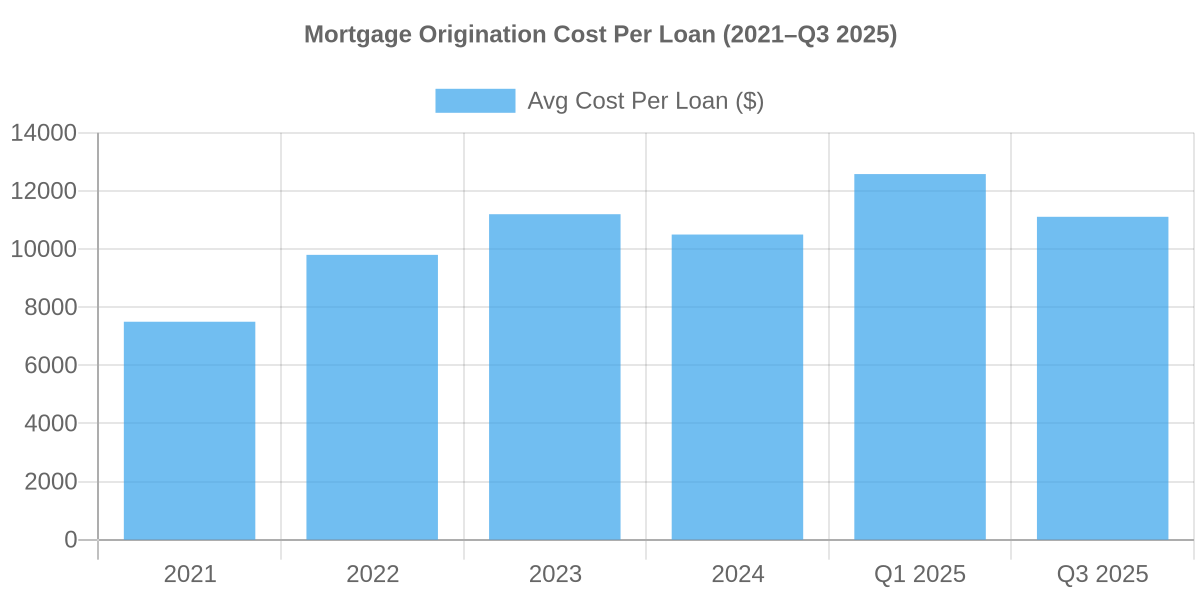
Sources: MBA Quarterly Mortgage Bankers Performance Reports (2021 to Q3 2025). Figures reflect independent mortgage banks and mortgage subsidiaries of chartered banks.
The firms winning that competition share one habit: they treat the loan file as a structured data problem, not a paper-shuffling problem. They invest in the systems that read, classify, and verify documents so their people don’t have to. And their loan officers spend the hours that were freed up on the phone, in front of real estate agents, and with borrowers who have questions no software can answer. That’s the actual job. The paperwork was never supposed to be it.
“The balance between automation and human oversight is where real progress is happening.”
HousingWire, reporting on lender efficiency priorities, May 2026. Read the full piece.
So the real question isn’t whether your team needs better tools. The data on origination costs, file fallout rates, and borrower expectations already answers that. The question is which part of your workflow to fix first, and whether you’re willing to track the numbers honestly enough to find out. Start with your re-request rate. Everything else will follow from there.