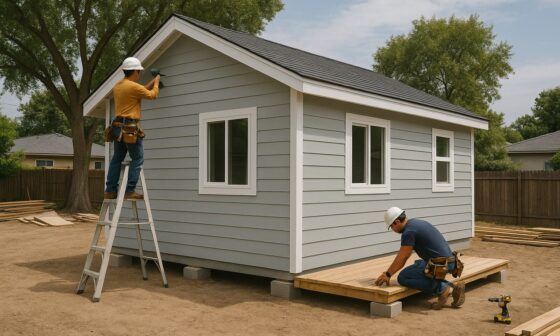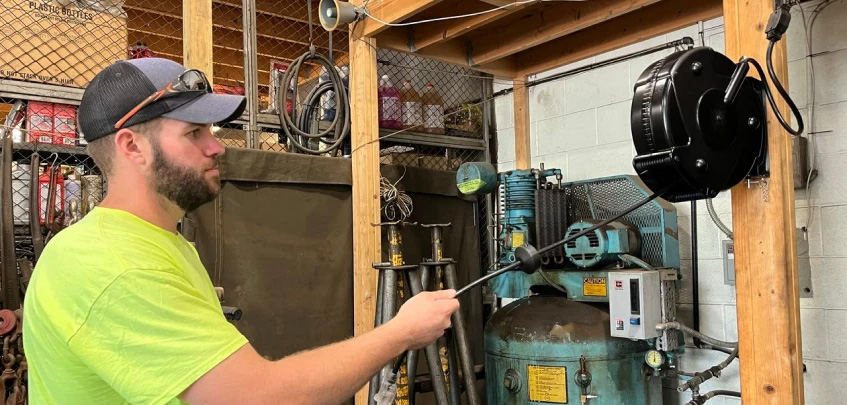
Extension cords are a routine part of many commercial and industrial jobs. Contractors use them to power tools across work areas, mechanics need access to electricity around service bays, and maintenance technicians move between equipment and workstations throughout the day. The challenge is not just getting power to the work area. It is managing the cord when it is not in use.
Loose extension cords can occupy valuable floor space, become tangled with other cables, and complicate movement around equipment and workstations. A retractable extension cord reel provides a more organized way to store and access power cords. Instead of leaving the entire cord extended, workers can pull out the required length and retract the unused portion when the task is finished.
ProReel from Alert Reel Manufacturing includes retractable cord reel configurations for different power-access arrangements. Contractors, mechanics, and service technicians encounter different workspace conditions, so the appropriate reel setup depends on whether power is needed across a project area, around a vehicle service bay, or at a fixed maintenance station.
The right setup depends on where the work takes place, how equipment is used, and how power needs to be accessed throughout the day.
Why Does Cord Management Matter in Commercial and Industrial Workspaces?
A work area can become difficult to manage when multiple extension cords remain spread across the floor. Cords may cross walkways, collect around equipment, or become mixed with other cables used for tools and machinery.
For contractors, this can make temporary work areas harder to organize. In automotive service bays, cords may need to reach different parts of a vehicle or workbench. Maintenance teams may also need power at several fixed workstations without storing long extension cords at each location.
A retractable cord reel addresses the storage side of this problem. The cord reel’s operating mechanism allows the cord to be deployed and stored according to the model’s specified operation.
This approach helps organize power access without requiring workers to handle and coil the entire extension cord after every use. It does not replace good electrical practices or appropriate cord routing, but it can make routine cord storage more manageable.
How Do Contractors Use Retractable Cord Reels on Job Sites?
Contractors often work across different areas of a project, using portable power tools, inspection equipment, and other electrical devices. The distance between the power source and the work area can change depending on the task and job-site layout.
A retractable cord reel can provide a designated power-access point in a workshop, service area, or suitable temporary installation. When mounted overhead or on a wall, it can keep the stored cord away from the floor while allowing users to extend it when required.
For contractors, the main consideration is how power needs to reach the work area as the project progresses. A fixed workshop or designated work zone may accommodate a wall- or ceiling-mounted reel, while a temporary installation requires attention to the available power source, mounting location, and cord routing. The cord reel should be selected for the tools and electrical requirements involved in the work. The ProReel retractable cord reel range provides a starting point for comparing available options.
How Can Mechanics Organize Power Access Around Service Bays?
Automotive workshops and repair facilities use electrical equipment across several work areas. Technicians may need power for diagnostic equipment, inspection tools, portable service equipment, and other devices used during vehicle maintenance.
A cord reel mounted near a designated service area can provide a defined location for power access. The cord can be extended toward the vehicle or workbench and retracted after use, rather than remaining stretched across the floor between jobs. The appropriate arrangement depends on the service bay layout.
Service-bay layouts can differ depending on the number of workstations, vehicle positions, and equipment used. A cord reel installed at a fixed bench may serve a different purpose from one associated with a mobile workstation. The mounting arrangement should account for how technicians access the vehicle and move equipment around the bay.
The electrical requirements also matter. A cord reel used with diagnostic equipment may have different requirements from one intended for a higher-current power tool. Mechanics and workshop managers should compare the connected equipment’s electrical requirements with the reel’s published ratings before selecting a model.
The 5020TFR is one ProReel configuration identified in Alert Reel Manufacturing’s selection guidance for mobile carts, tool carts, mobile furniture, and utility trucks. Its reverse-wired arrangement is intended for those types of mobile applications. It should not be treated as interchangeable with a standard wall-mounted reel; the installation and power arrangement need to suit the equipment.
How Do Service Technicians Benefit From Organized Cord Storage?
Facility service technicians often work across designated maintenance stations, equipment rooms, and repair points. Unlike a contractor working across a project area or a mechanic working around a vehicle, a facility technician may need recurring power access at fixed locations throughout the facility.
A retractable cord reel at a fixed maintenance workstation can provide access to power without requiring a separate extension cord to be stored and managed at the station. In areas where technicians regularly use compatible tools, a multi-outlet reel may also be worth evaluating.
For example, the 8140TP provides:
- 40 feet of 12/3 SJTOW cord.
- A 15-amp rating.
- Three grounded NEMA 5-15R outlets.
- A resettable circuit breaker.
- A thermoplastic housing and steel mounting bracket.
This configuration may be considered for a suitable fixed workstation where the connected equipment’s requirements fall within the model’s rating.
A single-outlet reel may be more appropriate when the installation is intended to supply one designated piece of equipment. The decision should be based on the connected load, outlet requirements, cord reach, and installation conditions rather than the number of outlets alone.
Where a facility has several maintenance stations, documenting the reel model and its installation details can help the team identify the appropriate configuration when a unit needs replacement or another workstation requires a similar setup.
What Features Should Buyers Compare When Selecting a ProReel Cord Reel?
The most suitable retractable extension cord reel is not necessarily the one with the longest cord or the greatest number of outlets. It is the configuration that matches the electrical and physical requirements of the installation.
Several factors deserve attention.
1. Cord Length and Reach
Measure the distance between the proposed mounting point and the area where power is needed. Allow for the normal movement of tools and equipment, and avoid selecting a cord length that leaves the cord stretched during regular use.
ProReel configurations include different lengths, depending on the model. The 8140TP, for example, has a 40-foot cord, while the 8645TFI has a 45-foot cord. Longer-reach models are also available.
2. Cord Gauge and Electrical Rating
Cord gauge, amperage, voltage, and the connected equipment’s electrical requirements must be considered together.
For instance, the 8140TP is rated at 15 amps, while the 8645TFI is a 20-amp configuration with a single NEMA 5-20R outlet. These are model-specific ratings, not specifications that apply to the entire ProReel range.
The connected load must remain within the reel’s published electrical rating.
3. Outlet Configuration
Consider whether the application requires one outlet or multiple outlets.
A single-outlet reel can suit a designated tool or equipment connection. A tri-tap or quad-outlet configuration may be appropriate where several compatible devices need access to the same power point.
Additional outlets do not increase the reel’s electrical capacity. The combined load must remain within its specified rating.
4. Mounting and Workspace Layout
Wall and ceiling mounting can provide different cord-routing arrangements. The proposed location should allow the cord to reach the work area without interfering with equipment, access points, or normal movement.
Also consider whether the installation is fixed or associated with mobile equipment. A standard fixed-mount reel should not automatically be specified for a moving workstation.
5. Operating Environment
Check whether the reel is intended for indoor use or has a specific environmental rating for the installation.
Standard indoor ProReel models should not be assumed suitable for outdoor, washdown, hazardous, or corrosive environments. Review the exact model documentation before specifying a cord reel for conditions outside its stated application.
When Is a Multi-Outlet Cord Reel Worth Considering?
Some workstations need power for more than one compatible device. In these situations, a multi-outlet retractable cord reel may provide a centralized power-access point.
For example, a maintenance bench may accommodate inspection equipment and portable tools, while an automotive service workstation may require access to several compatible devices.
A multi-outlet configuration can reduce the need to manage several separate extension cords at the same location. However, buyers must account for the combined electrical load and the reel’s maximum rating.
ProReel includes tri-tap and quad-outlet configurations, with different cord lengths and electrical specifications. Comparing these configurations against the actual equipment requirements helps determine whether a multi-outlet reel is appropriate.
What If a Standard Cord Reel Does Not Fit the Application?
Some contractor installations, service bays, and facility workstations may have requirements that fall outside the standard range. A specific mounting arrangement, cord configuration, or equipment connection may call for further review.
When a standard configuration does not meet the application, buyers can discuss a custom cord reel solution from Alert Reel Manufacturing. Feasibility and timing depend on the required configuration and engineering review.
Keep Power Accessible and Work Areas Organized With ProReel
Contractors, mechanics, and service technicians have different power-access requirements, but they share a common need to manage extension cords around their work areas.
A retractable cord reel can provide a defined storage and access point, allowing users to extend the required cord length and retract it after use. The appropriate configuration depends on the working reach, connected equipment, electrical rating, outlet arrangement, mounting location, and operating environment.
The goal is not simply to add a cord reel to the workspace. It is to establish a practical power-access arrangement that supports the way people work and keeps unused cords organized.