Key Takeaways
- Florida generally presumes that the rear driver was negligent in a rear-end collision.
- The presumption can be challenged when evidence suggests the front driver or another person contributed to the crash.
- The following distances must be reasonable for traffic, speed, and roadway conditions.
- Photos, witness accounts, vehicle damage, video footage, and crash reports can affect a fault determination.
- More than one driver may share responsibility under Florida’s comparative-fault rules.
Rear-end crashes on Red Bug Lake Road can happen in seconds, particularly where drivers encounter changing traffic signals, turning vehicles, school-area traffic, and congestion near busy shopping and residential areas. Although many people assume the driver who strikes another vehicle from behind is always at fault, Florida law treats that conclusion as a starting point, not an automatic final answer.
For individuals involved in a disputed crash in or near Casselberry, a lawyer specializing in personal injury cases, such as those at https://www.priorityjustice.com/personal-injury/casselberry-car-accidents-lawyer, can assist in reviewing the facts, records, and insurance matters. However, the most crucial initial step is to preserve clear evidence of how the collision took place.
Why the Rear Driver Is Usually Presumed at Fault
Drivers are expected to leave enough space to react to normal traffic conditions, including slowing vehicles, red lights, congestion, and routine stops. Florida’s following-too-closely law requires motorists to avoid following another vehicle more closely than is reasonable and prudent based on speed, traffic, and highway conditions.
That rule matters on Red Bug Lake Road, where traffic may compress near signalized intersections or slow for vehicles entering driveways, making turns, or stopping in queues. A driver who was distracted, speeding, tailgating, or unable to stop in time may have difficulty disputing fault after striking the vehicle ahead.
Florida courts have recognized a rebuttable presumption of negligence against the rear driver in a rear-end crash. In practical terms, the rear impact itself can lead to an initial inference that the trailing driver failed to exercise reasonable care. It does not mean the front driver is automatically free from fault in every situation.
When the Presumption Can Be Rebutted
A rear driver may present evidence showing that another person’s conduct contributed to the collision or that the rear driver was not the sole legal cause. The question is not simply who made contact. It is whether the available evidence supports a different explanation for why the crash occurred.
Sudden or Unreasonable Movement by the Front Driver
A fault dispute may arise if the lead driver abruptly changed lanes and immediately braked, reversed unexpectedly, pulled into traffic without enough room, or stopped for reasons unrelated to normal roadway conditions. A routine stop at a traffic signal is usually foreseeable. An unusual maneuver may require closer review.
Mechanical Failure or an Emergency
Brake failure, a tire problem, an unexpected medical emergency, or a roadway hazard may become relevant if reliable evidence supports the claim. These circumstances do not automatically eliminate responsibility. Investigators may still consider vehicle maintenance, the driver’s speed, available stopping distance, and whether the driver responded reasonably.
Chain-Reaction Collisions
Multi-vehicle crashes can be especially complicated. A driver may be pushed into the vehicle ahead after being struck from behind, or several impacts may occur so close together that the sequence is disputed. Vehicle damage patterns, dashcam footage, eyewitness accounts, and crash reconstruction evidence can help establish which impact happened first.
Evidence That Can Help Establish Fault
Evidence is often strongest when it is collected promptly and preserved in its original form. Anyone involved in a crash should prioritize safety and medical needs before taking photographs or gathering details.
- Scene photographs: Capture vehicle positions, lane markings, traffic signals, skid marks, debris, road conditions, and visible damage.
- Video footage: Save dashcam recordings and identify nearby businesses, residences, or vehicles that may have captured the collision.
- Witness information: Obtain names and contact details from people who saw the impact, lane movements, or traffic-light sequence.
- Vehicle records: Keep repair estimates, tow records, inspection reports, and photos taken before repairs begin.
- Crash documentation: Request the report number and review the report carefully for basic factual errors, such as an incorrect location, vehicle description, or sequence of events.
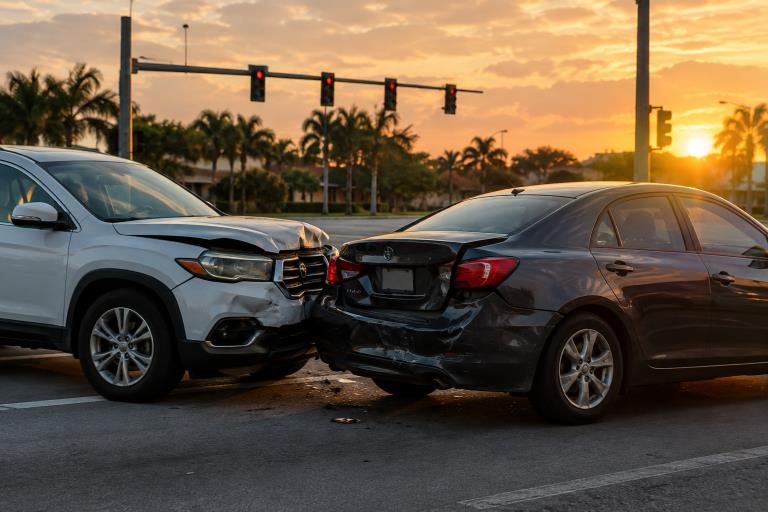
Damage location alone may not settle every issue, but it can be important. For example, direct rear-end damage may support one version of events, while side damage or evidence of multiple impacts may point to a lane-change or chain-reaction dispute.
Comparative Fault Can Apply to Both Drivers
Florida uses comparative-fault principles in negligence cases. That means responsibility may be divided among drivers and, in some situations, other parties whose actions helped cause a crash. The Florida Supreme Court has held that rear-end collision cases are governed by comparative negligence principles when evidence supports a question of the lead driver’s negligence or of another cause of the crash.
Under Florida’s comparative-fault statute, damages may be reduced by a claimant’s percentage of responsibility. In most negligence actions, a person found more than 50 percent at fault for their own harm cannot recover damages. A rear-end impact, therefore, does not end the analysis, but the evidence must provide more than speculation to shift or share fault.
Common Fault Arguments After a Red Bug Lake Road Crash
Insurance carriers may examine several recurring issues in rear-end claims. These include whether the rear driver was distracted, whether the front vehicle had working brake lights, whether a lane change occurred moments before impact, whether traffic stopped suddenly because of a signal, and whether weather or roadway conditions required a greater following distance.
Drivers should avoid making roadside admissions or guesses about speed, distance, or fault. A calm exchange of identification and insurance information is usually more useful than an argument. Later, written statements should be accurate and limited to facts the speaker actually knows.
What to Do After a Rear-End Collision
- Move to a safe location if possible and call 911 when someone is hurt or the roadway is unsafe.
- Exchange driver, vehicle, and insurance information.
- Photograph the scene and both vehicles when it is safe to do so.
- Seek medical attention for new, worsening, or concerning symptoms.
- Notify your insurer promptly and keep copies of every claim-related document.
- Preserve footage, damaged property, receipts, medical records, and communication with insurers.
Conclusion
Rear-end collisions on Red Bug Lake Road often begin with a presumption against the trailing driver, but fault is not decided by vehicle position alone. A sudden maneuver, a chain-reaction impact, mechanical evidence, roadway conditions, and credible witness accounts may all matter. Preserving the details early can make the difference between a simple assumption about fault and a fact-based explanation of what actually happened.