Changing renewal quotes, especially when it causes budgeting concerns for the next financial year, can be stressful for CIOs.
At least that’s what many CIOs who are shying away from the VMware licensing change are feeling. spiking their IT cost. With Broadcom’s acquisition of VMware, there’s been a licensing overhaul.
And the most enduring perpetual licensing for VMware no longer exists. Instead, there’s now a subscription bundle that keeps piling on costs and cutting down flexibility.
Their per-core pricing continues to have higher minimums. As of January 2026, Broadcom has terminated VMware Cloud Service Provider (VCSP) agreements. This change reduced the buying path and impacted smaller users and regional MSPs.
So, should you still be sitting on the problem? Absolutely not. Here’s what most CIOs are thinking regarding VMware licensing changes in 2026, and it’s something you should consider too.
VMware’s 2026 Licensing Overhaul: What Actually Changed
The short version: Broadcom killed perpetual licensing entirely. Everything is now subscription-based, structured around per-core bundles with minimum commit thresholds.
vSphere Foundation, for example, now bundles vSAN at 250 GiB per core, which sounds like more value until you realize you’re paying for storage capacity you may not need, and you can’t opt out.
NSX and Aria are no longer available as standalone products. If you want them, you’re buying the bundle that includes them, whether or not that aligns with your workload profile. That’s not flexibility, that’s forced packaging.
Late renewals now carry a substantial penalty, which is less a pricing policy and more a pressure tactic. Organizations that fell behind on renewal timelines during the acquisition chaos are discovering this the hard way. And VMware’s enterprise licensing costs are structured so that anything under roughly 16 cores per host gets hit proportionally harder. The per-core math is punishing at scale.
The VMware subscription model as it exists in 2026 isn’t a refinement of the old model. It’s a replacement, and a deliberately more expensive one.
Sangfor HCI: The Alternative That’s Actually Built for This Moment
Sangfor’s Hyper-Converged Infrastructure platform is, at its core, a unified compute-storage-network-security stack built on KVM. What makes it worth leading with in a MENA context specifically is the combination of factors that align with what regional CIOs actually need right now.
The licensing model is the obvious starting point. Sangfor offers perpetual licensing as an option. It’s something VMware no longer does. Thanks to that, infrastructure budgeting becomes predictable again. Therefore, CIOs need not worry about an annual subscription, a renewal penalty window, or bundle mandates for unnecessary features.
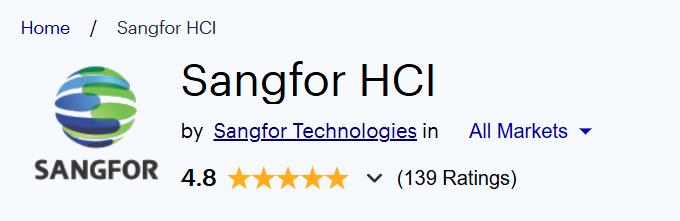
With its flexible licensing features and ease of customization, Sangfor remains one of the best VMware alternatives in the current market. No, it’s not a vague claim. In fact, Gartner has also ranked Sangfor HCI at 4.8 based on 139 genuine reviews.

Furthermore, most users have seen a significant reduction in TCO, often considerably lower than VMware’s. Plus, the migration becomes possible with Sangfor’s toolkits for customers, irrespective of their size.
Here’s the updated section with ~20-word descriptions for each component:
Sangfor HCI: The Alternative That’s Actually Built for This Moment
Sangfor’s Hyper-Converged Infrastructure platform is, at its core, a unified compute-storage-network-security stack built on KVM. What makes it worth leading with in a MENA context specifically is the combination of factors that align with what regional CIOs actually need right now.
The licensing model is the obvious starting point. Sangfor offers perpetual licensing as an option. It’s something VMware no longer does. Thanks to that, infrastructure budgeting becomes predictable again. Therefore, CIOs need not worry about an annual subscription, a renewal penalty window, or bundle mandates for unnecessary features.
With its flexible licensing features and ease of customization, Sangfor remains one of the best VMware alternatives in the current market. No, it’s not a vague claim. In fact, Gartner has also ranked Sangfor HCI at 4.8 based on 139 genuine reviews.
Furthermore, most users have seen a significant reduction in TCO, often considerably lower than VMware’s. Plus, the migration becomes possible with Sangfor’s toolkits for customers, irrespective of their size.
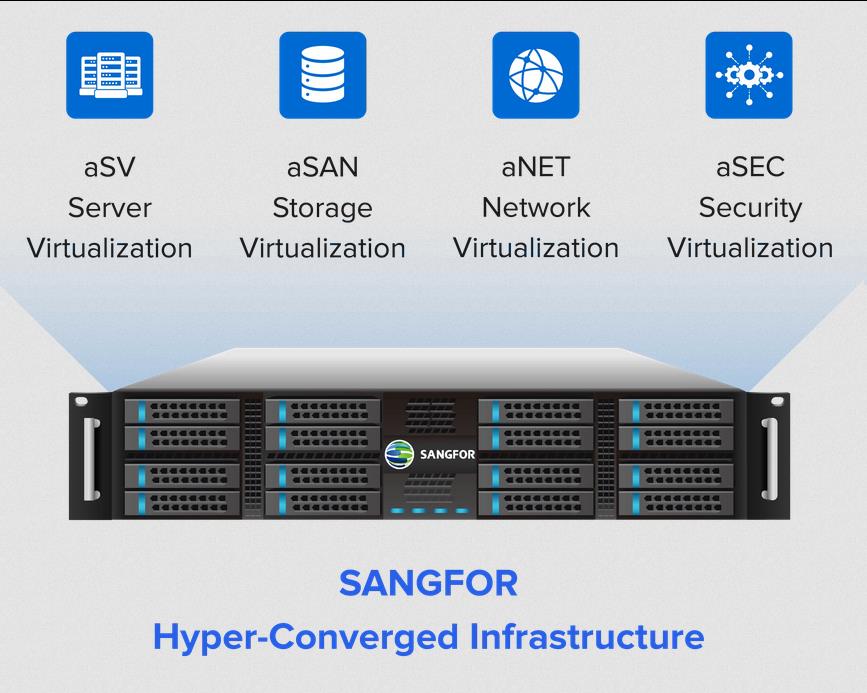
The platform’s four core components each solve a specific infrastructure layer:
- aSV (Server Virtualization): A bare metal Type 1 server virtualization hypervisor delivering near-native compute performance, kernel-level security hardening, and zero-downtime hot patching across workloads.
- aSAN (Storage Virtualization): A distributed, software-defined storage layer running on commodity x86 hardware, eliminating dedicated storage appliances while maintaining enterprise-grade resilience.
- aNET (Network Virtualization): An integrated SDN layer enabling teams to build and manage virtual networks through a visual interface, without specialized networking expertise or separate licensing.
- aSEC (Security): Security isn’t bolted on as an afterthought with Sangfor HCI. It’s baked directly into the platform through aSEC, its built-in cloud security center. Tools like vAF (virtual Application Firewall) and Endpoint Secure sit natively within the stack, giving IT teams a single operational view rather than a patchwork of separate consoles.
Other Alternatives Worth Knowing About
Sangfor isn’t the only name worth understanding. The honest version of this comparison looks like this:
Microsoft Hyper-V
Microsoft Hyper-V is effectively free for organizations already running Windows Server licensing, and the Azure hybrid integration is genuinely useful if your cloud strategy runs through Microsoft.
The limitation is HCI depth. It’s not a converged security-compute-storage platform like Sangfor is.
Nutanix AHV
Nutanix AHV is a mature enterprise platform with solid hybrid cloud credentials. However, the challenge is cost. Nutanix’s subscription model doesn’t solve the VMware pricing problem so much as replicate it at a different price point.
Proxmox VE
It is the open-source option that SMBs with in-house technical capabilities keep gravitating toward. It’s cost-effective at the core, no question. But enterprise SLAs, regional support, and the compliance tooling that MENA government and financial sector organizations require. Proxmox doesn’t get you there without significant additional investment.
Cisco HyperFlex
Cisco HyperFlex integrates well with UCS infrastructure if you’re already in a Cisco-heavy environment, but it’s pricier than Sangfor and less flexible in licensing structure. For organizations not already invested in Cisco’s stack, the case for switching to it over Sangfor is hard to make.
How Much Will VMware Licensing Actually Cost in 2026?
Most clusters running on 16+ cores per host face a sharp increase in renewal costs due to per‑core bundles that charge for vSAN and NSX regardless of usage. Gartner recommends treating VMware 2026 costs as significantly higher than 2024 and planning migrations early to avoid weak‑position negotiations.
However, Sangfor solves this problem for virtual cloud infrastructures by reducing TCO by up to 70%.
What’s the Fastest Realistic Path for VMware Migration in 2026?
Sangfor’s 30-to-60-day migration framework is currently the most credible fast‑path, using phased hybrid coexistence to run Sangfor HCI alongside VMware and retire workloads with minimized downtime.
They provide extensive and specialized tools for migration, especially VMware migration. CIOs can easily migrate their workload from VMware to Sangfor HCI. The Sangfor Cloud Migration Tool for P2V, V2V, and C2C migrations offers options for both agent-based and agentless migrations, both online and offline.
Gartner’s timeline data is clear: organizations that delay evaluation face compressed, costlier six‑to‑nine‑month migrations, often forced into Q1 deadlines under budget pressure. In short, that’s a position you want to avoid.
2026 Is the Year to Stop Delaying This Decision
VMware’s licensing shift is permanent. Broadcom’s per‑core subscription model is now the baseline, not a negotiable phase. For CIOs balancing infrastructure budgets with aggressive digital transformation goals, this requires an immediate, structured evaluation, not a “next‑cycle” wish.
Sangfor HCI stands out as the strongest VMware alternative because it delivers predictable licensing, a fast, proven migration path, and a unified security‑plus‑infrastructure stack that eliminates VMware’s add‑on cost spiral.
Organizations that began evaluating in early 2025 are already done; those starting now still have runway. Waiting another renewal cycle shortens it dramatically. A free TCO assessment takes under a week and pays for itself in insight.