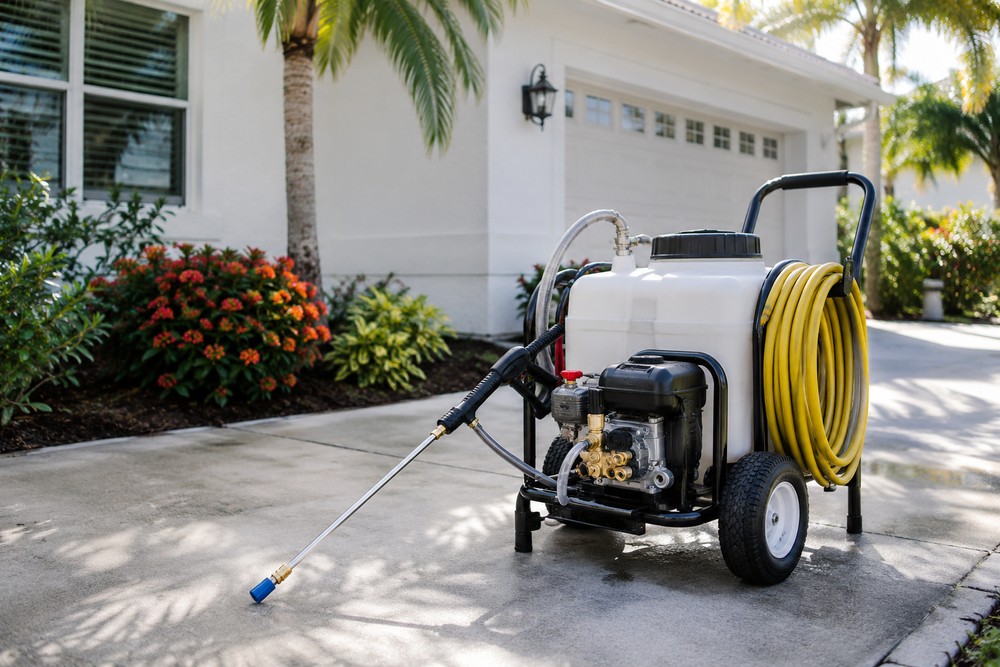
Anyone can rent a pressure washer for $90 at the hardware store on a Saturday. What you can’t rent is a license, a liability policy, or the training that keeps a 3,000 PSI tip off your shingles. That difference decides everything.
St. Johns sits in the 32259 corridor, and if you live anywhere near Fruit Cove or Julington Creek you already know the routine: heavy tree cover, humidity that never quits, and green siding that comes back every single year. Hiring the wrong crew in that environment doesn’t just waste money. It can strip paint, gouge pavers, and void a roof warranty. If you want a crew that already knows that terrain, Pressure washing St. Johns is a useful reference point for what a certified local operator looks like. So here’s what actually separates a licensed operation from a weekend side hustle, and how you check it in about ten minutes.
License, Insurance, and the Paper Trail That Matters
Start with the boring stuff, because the boring stuff is where unlicensed crews fall apart. A legitimate pressure washing business in Florida carries a state or county business tax receipt, general liability insurance, and in many cases workers’ compensation coverage as well. Request the certificate of insurance yourself, straight from the carrier or the agent. Not a photo of a card, not a “we’re fully insured” text message. The actual certificate, with your address listed as the job site.
What does that have to do with your house? Plenty, because if an uninsured worker falls off a ladder on your property, your homeowner’s policy is the one that gets the claim. That’s a real risk, and it’s the kind of thing nobody thinks about until it happens. A licensed crew takes that exposure off your plate.
Then there’s the roof question. High pressure on asphalt shingles blows granules loose and shortens roof life, and once the granules are gone they don’t grow back. The Environmental Protection Agency’s records on regional industrial water discharge show how seriously pressure and runoff get regulated at scale, which tells you something about why trained crews treat water volume and pressure as a controlled variable rather than a dial to crank. EPA records
Soft Wash Certification Is the Actual Dividing Line
Here’s the thing most homeowners don’t know: pressure washing and soft washing are different trades. Soft washing uses low pressure and a cleaning solution to kill the organic growth, then rinses it away. Pressure washing blasts dirt off a hard surface. Applying the second method to a roof or painted siding is how you end up with a $12,000 problem.
A certified soft wash crew has been trained on dilution ratios, dwell time, and which surfaces can take what. They know that a vinyl-sided house in Nocatee needs a different mix than a stucco wall near the beach. They also know when to walk away from a job, which is a skill you want in a contractor.
Residential policies at institutions like St. John’s College spell out surface care and maintenance obligations in detail, and the same principle applies to your house: the material dictates the method, not the other way around. housing policies
This is where I’d push back on price shopping. A $150 quote and a $450 quote for the same driveway usually aren’t the same job. One of them is a guy with a wand and a gallon of bleach. The other is a crew that will pre-treat, rinse, and come back if a stain doesn’t lift.
What a Real Crew Does Before the Truck Even Pulls In
Licensed operators run a walkthrough first. They look at your gutters, your downspouts, your window seals, and any plants close to the foundation. They ask what’s under the deck. They tell you which stains will probably come out and which ones won’t. Good ones will put that in writing.
Compare that to the fly-by-night version: shows up, blasts everything, hands you a cash invoice, and stops answering the phone when the paint peels three weeks later. You’ve seen that truck parked down the street. You recognize it on sight.
I’d rather pay more for a crew that tells me my 12-year-old roof needs a soft wash and a follow-up in 18 months than save $200 and gamble on the shingles. Nothing wrong with hunting for a deal. The arithmetic just doesn’t favor it here.
A Ten Minute Checklist Before You Book Anyone
- Ask for the certificate of insurance and confirm the job address is listed.
- Ask what method they’ll use on your roof, and if the answer is “pressure,” hang up.
- Get the quote in writing, including what happens if a stain doesn’t lift.
- Ask how long they’ve worked in St. Johns County specifically, since local humidity and tree cover change the approach.
- Check whether they offer a callback window if something looks off after the job.
Run that list against two or three companies and the field narrows fast. Most of the unlicensed operators drop out at question one.
The Local Advantage Nobody Talks About
There’s a practical reason to hire someone based in the 32259 corridor rather than a crew driving in from an hour away. A local operator knows that roofs in Julington Creek grow algae faster than roofs in parts of Duval County because of the tree canopy and shade. They know which neighborhoods have HOA rules about runoff and which don’t. And they can come back in 20 minutes if something needs a second look.
Tennessee’s utility regulatory filings show how thoroughly documented and inspected service work gets handled in regulated industries, and while pressure washing isn’t a utility, the same logic applies to any contractor who has to stand behind the work. regulatory filings
That’s what you’re really buying when you hire a licensed crew. A cleaner surface matters, sure, but what you’re paying for is a business with a name, an address, and something to lose if they get it wrong.
Before You Hand Over a Deposit
Licensing, insurance, and soft wash training separate a real crew from a rented machine, and the checklist above will tell you which one you’re talking to in about ten minutes. The homeowners who get burned are almost always the ones who skipped the paperwork because the price looked good.
So here’s the question worth asking yourself: if the crew you’re about to hire damages your roof, do you know who pays? If you can’t answer that with confidence, you already have your answer.