Walk through any large building and you’ll see the same mistake repeated. The letters are bold. The contrast is sharp. The typeface is clean.
And yet people still stop and look around, unsure where to go.
Font size usually gets the blame for failed visibility. In reality, installation height plays a much larger role in whether signage is actually seen.
The Natural Line of Sight
Most adults walk with their gaze angled slightly downward. This is especially true when they are indoors. They scan at eye level and just below it, not above their heads.
If a sign is mounted too high, even large lettering won’t fix the problem. People simply don’t look there unless they are already searching intensely.
The most legible type in the world cannot compete with human habit.
Effective placement starts by respecting how people move through space.
Movement Changes Reading Angles
Visibility is not static. It shifts with motion.
People’s eyes track forward as they walk down the corridor. A sign placed several feet above eye level forces an unnatural head tilt.
In busy environments, that extra effort means the sign gets skipped.
Font size increases legibility only if the sign falls within the viewer’s natural field of vision.
Height determines whether the sign enters that field at all.
Distance and Perspective
As installation height increases, the viewing angle becomes steeper.
A sign mounted too high can distort readability because the viewer approaches from below. The letters may be large, but perspective reduces clarity.
Lower placement allows the text to face the viewer more directly.
This matters especially in long hallways and open lobbies where distance changes quickly as people approach.
Height affects how quickly the message registers.
Healthcare Environments Prove the Point
In hospitals and clinics, people are often stressed. They are not casually browsing for information.
They scan quickly and move with purpose.
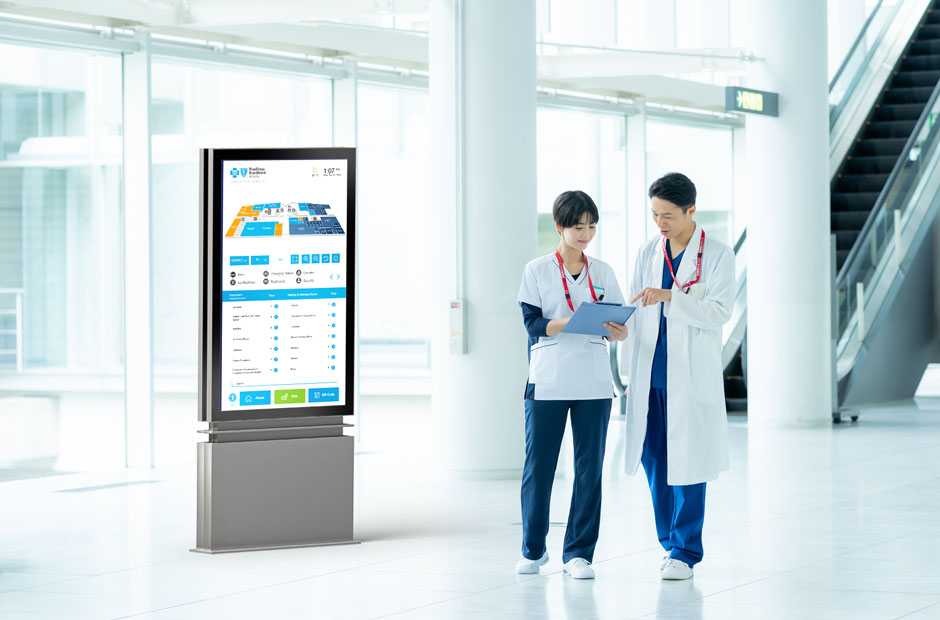
A well-designed healthcare signage system accounts for this by aligning signage with average eye level and predictable traffic flow.
Even with moderate font sizes, properly positioned signs are easier to process than oversized text mounted too high.
Patients rarely stand still and study signs carefully.
Placement has to anticipate motion.
Ceiling Height Can Mislead Designers
Large ceilings often tempt designers to mount signage higher than necessary.
The space feels tall, so the sign gets elevated to “match” the architecture.
The result is visual disconnect.
People walking through a tall atrium are still scanning at human height. A sign mounted several feet above eye level blends into background structure.
It becomes part of the architecture rather than part of the navigation system.
Font size cannot overcome poor alignment.
Visual Clutter Competes for Attention
Modern interiors often include lighting fixtures, monitors, decorative panels, and suspended elements.
Signs mounted too high may compete with these features.
When multiple objects occupy the upper field of vision, the brain filters aggressively.
Lower installation reduces competition and allows the sign to stand out against cleaner wall space.
Height simplifies the visual environment.
Accessibility Considerations
Installation height also affects accessibility.
Children, wheelchair users, and individuals of different statures experience space differently.
When signs are mounted at a consistent and thoughtful height, they become readable to a broader range of people.
Increasing font size does not solve access if the placement excludes part of the audience.
Visibility includes physical reach and line of sight.
Testing Placement in Real Conditions
The most reliable way to evaluate signage is to observe movement.
Stand at the entrance. Walk the route. Notice when your eyes naturally land on the sign.
If you have to search upward, the placement may be wrong.
If the message reads clearly without adjusting posture, height is likely correct.
Font adjustments come after placement decisions.
Not before.
Why Font Size Gets the Credit
Font size is measurable. It feels controllable.
Design teams can increase it quickly during revisions. It appears to solve readability concerns.
But size without proper placement creates oversized signs that still get ignored.
Height works quietly. It aligns with human behavior rather than fighting it.
In practical environments, especially complex facilities, people rarely analyze signage consciously.
They respond to what enters their natural field of vision.
Installation height determines that entry point.
When height is correct, moderate fonts perform well.
When height is wrong, even massive letters struggle.
Visibility begins with where the sign sits in space.
Only then does font size matter.