Most of us walk past them every day without a second thought. They blur into the urban background alongside streetlamps, fire hydrants, and crosswalk signs. But public seating is quietly undergoing a renaissance.
As modern cities grapple with skyrocketing rates of social isolation and the lingering effects of a digital-first world, urban planners are having a revelation. They are realizing that solving the complex problem of urban loneliness doesn’t necessarily require multi-million-dollar community centers or massive technological interventions. Sometimes, the most powerful catalyst for human connection is simply giving people a place to sit down.
The Psychology of the “Pause”
Modern urban environments are heavily engineered for velocity. Wide sidewalks, timed crosswalks, and streamlined transit hubs are all designed to move the maximum number of humans from Point A to Point B as quickly as possible. This creates a highly efficient city, but a deeply anonymous one. When a street is designed solely for movement, people keep their heads down, their headphones in, and their pace brisk.
To break this cycle of anonymity, urban planners have to engineer a “pause.”
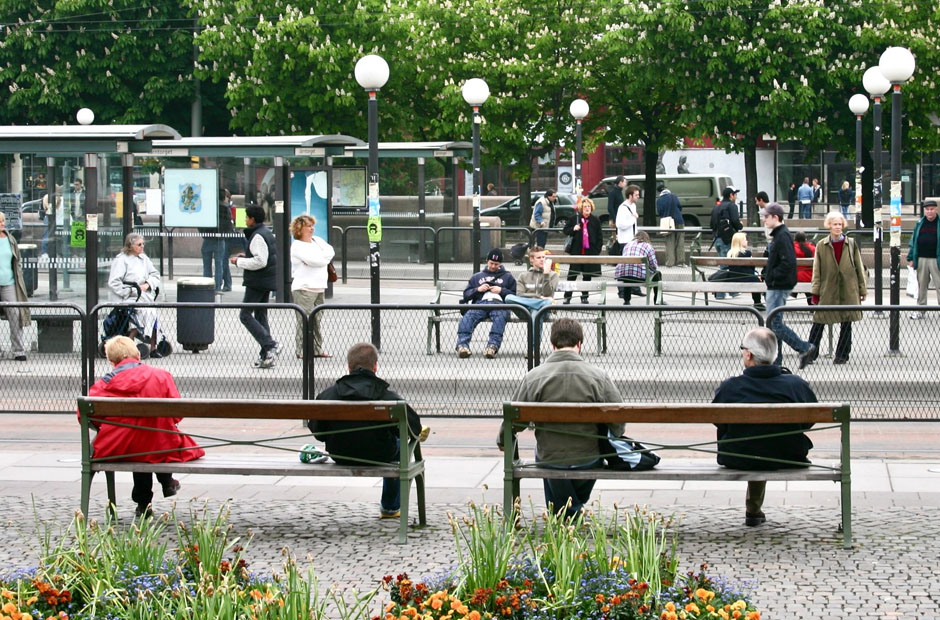
Placing a seat in a public square or along a busy thoroughfare disrupts the visual and physical flow of the space. It acts as an invitation to stop. When people stop moving, their spatial awareness shifts. They look up from the pavement. They observe their surroundings. They share physical proximity with strangers in a way that feels safe and unstructured. This proximity is the absolute baseline requirement for community building; you cannot connect with your neighbors if you never share space with them.
The End of Hostile Architecture
For the last few decades, many municipalities took the exact opposite approach. Driven by a desire to prevent loitering and discourage the unhoused population from occupying public spaces, cities embraced “hostile architecture.”
This resulted in bus stops with slanted seats you couldn’t actually rest on, benches with rigid armrests dividing every foot of space, and concrete ledges embedded with metal spikes. While these designs achieved their goal of keeping people moving, they had a devastating secondary effect: they made the city feel unwelcoming, aggressive, and cold to absolutely everyone.
Today, progressive urban design is pivoting hard toward inclusive placemaking. The goal is to create “sticky streets”—environments where people actively want to linger. When a neighborhood has comfortable, accessible places to sit, elderly residents can comfortably walk further from their homes, parents can let their children play longer in local squares, and local businesses see a massive boost in foot traffic.
Durability as a Sign of Dignity
When a city or a corporate campus decides to invest in public seating, it isn’t just a matter of aesthetics; it is a matter of endurance and the psychological message that endurance sends.
Public infrastructure takes a brutal beating. It must withstand extreme temperature fluctuations, torrential rain, road salt, accidental impacts, and the relentless wear-and-tear of thousands of daily users. If a city installs cheap, flimsy furniture that immediately rusts, chips, or breaks, it sends a subconscious message to the neighborhood that the space—and by extension, the people in it—are not valued.
Conversely, installing robust, highly engineered infrastructure signals a long-term commitment to the area. When landscape architects specify heavy-duty fixtures like Global Industrial park benches, they are utilizing materials designed to survive the harsh reality of the outdoors without losing their structural integrity. Thick, thermoplastic-coated steel and industrial-grade aluminum don’t just resist vandalism and weather; they provide a permanent, reliable anchor for the community. It tells the public, “This space is cared for, it is permanent, and you are welcome to stay here.”
The “Eyes on the Street” Security
Beyond community building, strategically placed seating is one of the most effective, unheralded safety measures a city can deploy.
In the 1960s, urban activist Jane Jacobs coined the phrase “eyes on the street.” She argued that the safest neighborhoods were not the ones with the most police, but the ones with the most active street life. When a street has places for people to sit, drink a coffee, or read a book, it is passively monitored by dozens of citizens. This natural, informal surveillance dramatically deters crime and anti-social behavior. A well-placed bench effectively acts as a neighborhood watch post, manned entirely by people who are just enjoying a sunny afternoon.
The Architecture of Connection
In an era where our lives are increasingly lived through screens and isolated in private spaces, the public realm has never been more important. We need physical spaces that force us to bump into one another, to share the shade of a tree, and to observe the beautiful, chaotic rhythm of our own neighborhoods. The humble public bench is not just a piece of furniture; it is the foundational architecture of human connection.