Enterprise mobile portfolios in North America carry a quiet cost. Many apps still run on aging native codebases, fragile APIs, dated authentication flows, and UI patterns that predate current customer expectations. They may still function, but they slow release cycles, inflate support effort, and make product teams cautious.
That caution hurts growth targets. A VP of Engineering may need faster feature delivery. A Head of Customer Experience may need higher task completion. A platform leader may need fewer app variants across business units. Legacy mobile apps create friction across all three.
This is why more enterprises now treat mobile app development as modernization work, not only product work. In 2025, Pega and Savanta estimated that the average global enterprise wastes more than $370 million each year through technical debt tied to legacy systems. Mobile may not account for the entire loss, but it shows the size of the problem that leaders now need to contain.
The issue goes beyond cost. Legacy apps limit AI adoption because they lack clean data flows, modern event tracking, reusable design systems, and modular service layers. Product teams cannot personalize experiences or ship AI-assisted workflows when the app architecture resists change.
AI-Powered UX Changes The Rebuild Case
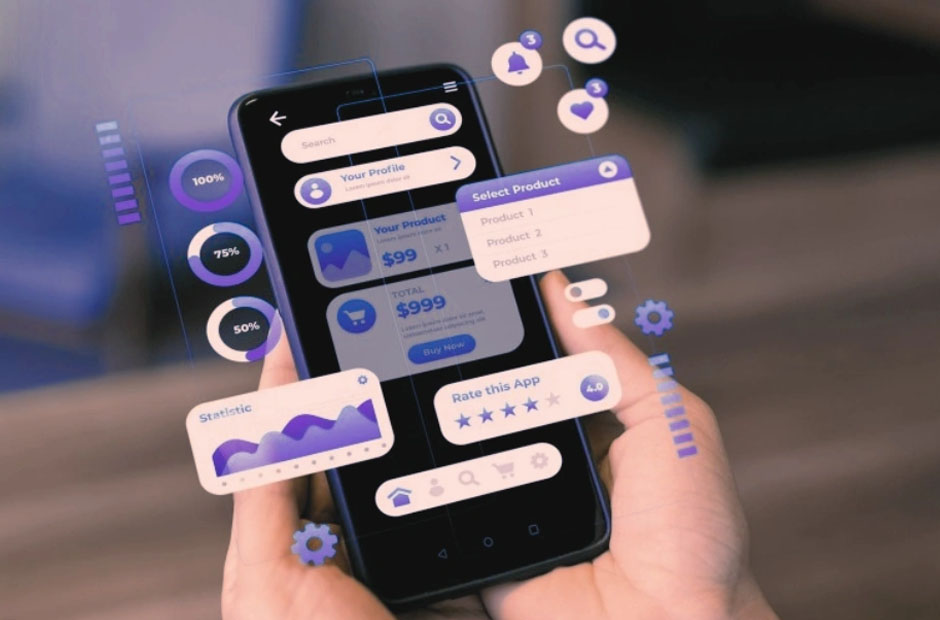
Rebuilding a mobile app no longer means copying old screens into a new stack. AI-powered UI/UX gives enterprise teams a better way to diagnose where the app loses users, where workflows add effort, and where automation can remove manual steps.
For large organizations, that matters because app modernization must tie to business outcomes. A claims app should reduce call center volume. A field service app should reduce technician time. A retail app should improve checkout completion. A financial services app should lower abandonment during verification.
AI helps teams test those assumptions. It can analyze support tickets, session patterns, search behavior, and user journeys. It can surface which tasks need redesign before engineers rewrite code. Design teams then turn those findings into journeys that match user intent, compliance needs, and platform constraints.
React Native fits this pressure because it supports shared mobile logic across iOS and Android while still allowing native level integrations. Enterprises that hire React Native developers often want one team that can move across platforms, support design system adoption, and reduce duplicate engineering effort without giving up device capabilities.
The goal is not a cheaper app. The goal is a mobile platform that can change with the business.
What Leaders Should Inspect Before Committing to the Budget
Modernization fails when teams frame the rebuild as a UI refresh. Leaders need a sharper view of the app estate before they approve the roadmap.
They should inspect the release pipeline, API dependency map, analytics coverage, design system maturity, accessibility gaps, crash patterns, app store feedback, security posture, and internal team capacity. Each factor affects delivery risk.
Ensono’s 2025 State of IT Modernization report found that budget pressure limits innovation for 86 percent of IT leaders and that nine in ten cite talent gaps as a primary modernization barrier. That aligns with what enterprise mobile leaders see: the blockers often sit between architecture, staffing, and decision speed.
A practical rebuild plan starts with a diagnostic sprint. The team maps technical debt, identifies workflows that need AI assistance, defines a React Native architecture strategy, and decides which native modules need direct platform work. This prevents a long rewrite that creates a newer version of the same problem.
5 U.S. Digital Product Development Partners for AI-Led Mobile Modernization
1. GeekyAnts
GeekyAnts is an AI-Powered Digital Product Engineering & Consulting Company with experience across mobile engineering, React Native, design systems, AI product engineering, and enterprise modernization. Its relevance for North American buyers comes from its mix of product strategy, UI/UX, and engineering delivery for teams that need to rebuild apps without stalling roadmaps.
Clutch rating: 4.8 with 113 verified reviews. Address: GeekyAnts Inc, 315 Montgomery Street, 9th and 10th floors, San Francisco, CA, 94104, USA. Phone: +1 845 534 6825. Email: info@geekyants.com. Website: www.geekyants.com/en-us.
2. Simform
Simform suits enterprises that need product engineering, cloud modernization, data engineering, and experience transformation in one operating model. Its mobile work connects with broader platform needs, which makes it relevant when a mobile rebuild depends on cloud services, APIs, data platforms, and AI readiness.
Clutch rating: 4.8 with 84 verified reviews. Address: 111 North Orange Avenue, Suite 800, Orlando, FL 32801, USA. Phone: +1 321 237 2727
3. Simpalm
Simpalm focuses on mobile app development, web development, maintenance, and product support for organizations that need hands-on delivery with a smaller team model. It can fit companies that want to rebuild customer apps, internal platforms, or workflow tools with a defined scope and tight collaboration.
Clutch rating: 4.9 with 64 verified reviews. Address: 11821 Parklawn Drive, Suite 130, Rockville, MD 20852, USA. Phone: +1 301 541 3076
4. Fueled
Fueled brings mobile app development, UX/UI design, web development, and brand-aware product execution. It suits digital product leaders who need app experiences that combine design strategy, iOS and Android delivery, and post-launch iteration. Its profile fits enterprises that view modernization as both an engineering and customer experience program.
Clutch rating: 4.9 with 37 verified reviews. Address: 430 W 14th Street, New York, NY 10014, USA. Phone: +1 212 763 7726
5. Blue Whale Apps
Blue Whale Apps works across mobile app development, UX/UI design, web development, AI consulting, and low-code delivery. It can support teams that need a rebuild partner with healthcare, enterprise workflow, and customer-facing app experience. Its service mix makes it relevant for organizations linking mobile modernization with workflow automation and generative AI experiments.
Clutch rating: 4.8 with 24 verified reviews. Address: 13800 Coppermine Road, 1st Floor, Herndon, VA 20171, USA. Phone: +1 561 753 0776
Final Thoughts
Legacy mobile apps will keep consuming budget until leaders connect modernization to measurable outcomes. AI-powered UX helps teams rebuild around user intent, not internal assumptions. React Native gives engineering teams a practical path to shared delivery across platforms while keeping room for native depth where the product needs it.
For enterprises planning 2026 and 2027 budgets, the right first move is a focused assessment of app architecture, user journeys, data readiness, and delivery capacity. That conversation can reveal whether the team needs a refactor, a rebuild, a React Native migration, or a phased modernization roadmap.