I spent $340 on golf balls last season. In April. That is not a typo, and the pain lasted longer than the balls did. If you play twice a week, you are feeding a machine that eats a sleeve every few rounds whether you like it or not. Water hazards do not care about your budget. Cart paths do not negotiate. So the real question is not whether you will lose balls, it is whether you will keep paying full retail for the privilege.
You will not, once you understand how the used ball market actually works. The plan below covers where to look on your home course, how to grade what you find, and when buying a retired premium ball beats buying a fresh mid-tier one. Stick with it and you can cut your ball spending by more than half without touching your score.
Why Paying Full Price Is a Tax on Being New
Here is the thing nobody at the pro shop will tell you: a golf ball has one job for the first nine holes and a completely different job after that. The cover scuffs, the paint dulls, and the ball keeps flying. Nothing about your swing changes because the logo is faded.
Club and ball manufacturers design their products to meet equipment standards set by the USGA, and those standards apply to every conforming ball regardless of how many rounds it has seen. A ball either fits the rules or it does not. Retail price is not part of that equation.
So when you pay $50 for a dozen, you are paying for the first round, the packaging, the marketing, and the shelf space. By round three, you are the only person who still notices the difference.
Where Do All the Lost Golf Balls Actually Go?
Somewhere on your course right now, there are hundreds of playable balls sitting in places nobody looks. Not the water. Not the deep rough. The places that require two extra seconds of attention.
Walk these spots on your next twilight round and you will fill a pocket before the turn:
- Six feet inside the tree line, not at the edge, where balls roll after clipping a branch.
- The strip between two adjacent fairways, which is nobody’s favorite place to search.
- Behind every green, roughly pin high, where approach shots release long.
- The low side of any mound or swale, which collects balls the way a gutter collects leaves.
- Under the cart path bridge or culvert on the par-three over water. This one is a goldmine.
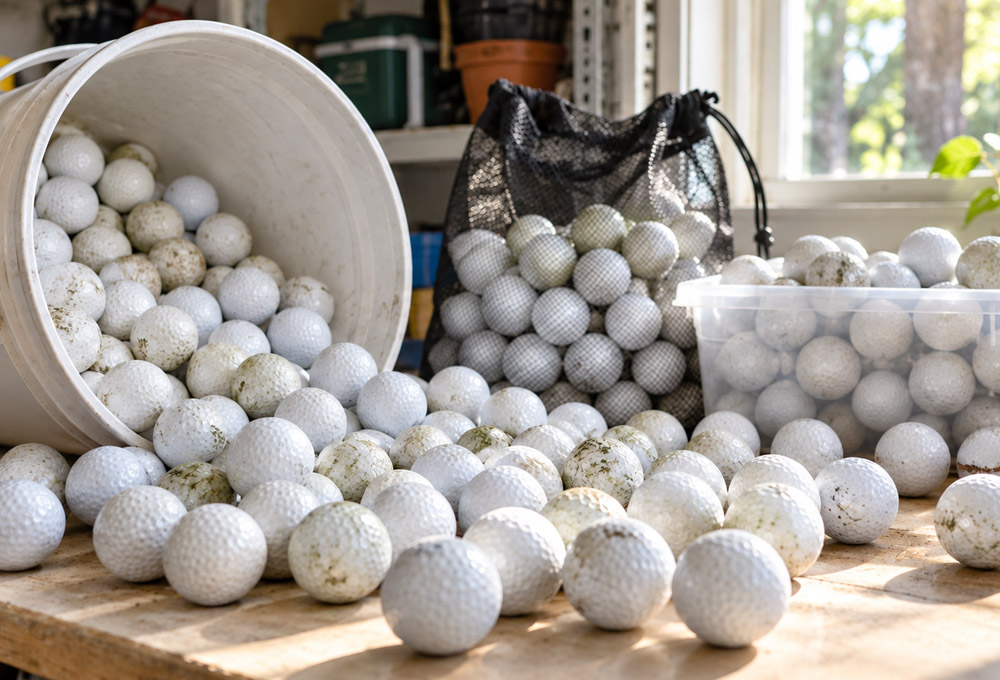
I found eleven balls under one culvert at my home course last spring. Nine of them were premium models that had been sitting there long enough to grow a beard of algae. A wet towel fixed all of them.
How to Grade a Found Ball in Ten Seconds
Not every ball you pull out of the mud deserves a spot in your bag. Grading is a skill, and it gets fast once you have a system. I call mine the Sunday Box, because the better finds go in a separate pouch that only comes out for weekend rounds when I actually care about spin.
Run every found ball through these checks in order:
- Cover integrity. Run your thumbnail across the cover. If it catches on a cut or a deep gouge, the ball is done for you and fine for the shag bag.
- Roll it across a flat cart path. A wobble means a warped core, which means unpredictable roll on the green.
- Dirt comes off. Discoloration from sitting in water for months usually does not, and a stained ball is a practice ball.
- Water damage. Balls that spent a long time submerged can take on water through the cover, which changes weight and flight. If it feels heavy or sounds dull when you bounce it, retire it.
Anything that passes all four checks goes in the Sunday Box. Everything else goes to the shag bag or back to the course. Be honest with yourself here, because a bad ball costs you more strokes than it saves you dollars.
Buying Used Beats Buying Cheap, and It Is Not Close
Here is where most golfers get the math wrong. They see a dozen premium balls for $20 and assume it is a downgrade. It usually is not. You are getting a top-tier ball with cosmetic wear, and that beats a brand-new budget ball on every measurable front: spin around the green, feel off the putter, durability in wind. The used market runs on sorting. Balls get collected, cleaned, graded, and sold by condition tier, which is why you will see a wide spread in price for what looks like the same product. A reputable seller publishes its rating scale and sticks to it. If a listing does not explain what “mint” or “grade A” means, walk away.
Two rules keep you from getting burned. Buy from a seller who guarantees the balls are water-collected or hand-sorted rather than mystery bags, and check the return policy before you commit. Retail protections exist for a reason, and the Federal Trade Commission publishes consumer guidance on online purchase protections if you want the details. Used does not mean unprotected. This is also where brand loyalty pays off. If you have been playing one model for years, you already know how it feels off the face. Buying that same model a few grades down costs you nothing in familiarity and a lot less at checkout. I stayed loyal to Callaway for exactly this reason, because switching models mid-season is a bigger adjustment than switching to a slightly scuffed ball.
Your Practical Stockpile Plan for the Season
You do not need a warehouse. You need a rhythm. Here is the system I run from March through October, and it takes about fifteen minutes a week.
| When | Action | Target
|
| Every twilight round | Ten-minute scavenge on the five spots above | 3 to 5 playable balls |
| Twice a month | Grade the stash, move rejects to the shag bag | Keep the Sunday Box full |
| Mid-season | Buy a bulk used lot in your preferred model | Refill before you run dry |
| End of season | Clean everything, store dry, check next spring | Avoid moisture rot |
Timing matters more than people think. Weather drives how much you play and how many balls get abandoned, and seasonal patterns from the National Oceanic and Atmospheric Administration give you a rough sense of when your region will dry out and the courses will fill up. More rounds played means more balls lost, which means better scavenging in the weeks right after a busy stretch.
The mid-season bulk buy is the move most golfers skip. They wait until they are down to two balls in the bag, panic, and pay retail at the course. Buy in June or July when your stash is thinning and you can afford to wait for a good lot instead of grabbing whatever is on the shelf.
A Stockpile Is a Strategy, Not a Closet Full of Balls
You will never stop losing golf balls. That is the game. But you can stop paying premium prices for something that spends half its life in a pond. Scout your course, grade honestly, buy used in the model you already trust, and refill before you run out. Do that and the $340 April will not happen again.
Next time you are standing over a shot with water short and right, ask yourself one question: is this a Sunday Box ball, or a shag bag ball? Answer that honestly and you have already won the mental game. And if your stash is looking thin right now, start with a bulk used lot in your go-to model before you pay retail again.