Key Takeaways
- Emergency response skills may feel less automatic when they are practiced only during formal renewal training.
- Brief, recurring drills can help teams clarify roles, locate equipment, and reduce hesitation.
- Communication, leadership, and technical skills all affect how a response unfolds.
- Practice is most useful when it reflects the team’s actual rooms, equipment, workflows, and staffing realities.
- Renewal records, equipment checks, and respectful debriefs support a more reliable readiness routine.
Readiness Is Built Between Emergencies
Healthcare professionals may complete required training and still feel uncertain when a real emergency occurs. That reaction is understandable. A crisis requires people to recognize a problem, call for help, retrieve equipment, begin care, communicate clearly, and prepare for handoff, often within minutes. Completing online BLS recertification can provide an important foundation, but workplace readiness also depends on how well a team can apply those skills together.
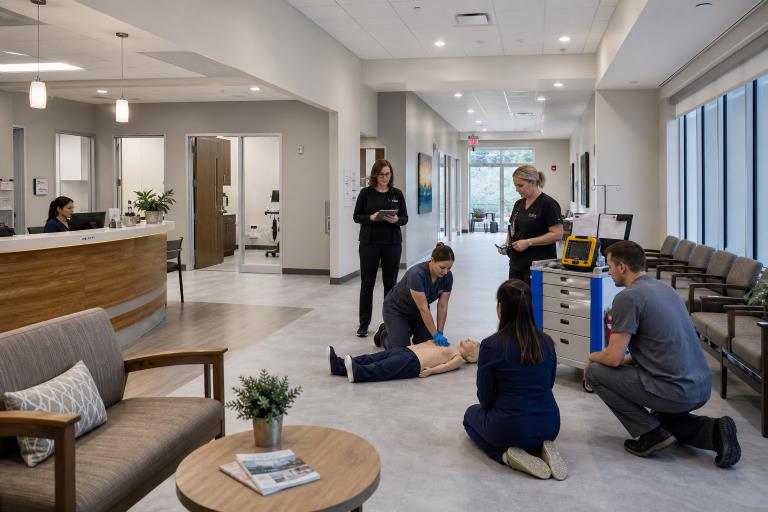
Consider a small clinic where a patient suddenly collapses in the waiting room. One staff member starts assessing the patient, another searches for the AED, and a third assumes someone else has called emergency services. No one is necessarily unprepared, but unclear roles can create delays. Short, repeated practice helps turn those uncertain moments into a more coordinated response.
Why Skills Fade Without Regular Practice
Emergency response is not one isolated skill. It is a chain of actions that can include checking the scene, recognizing deterioration, activating the local emergency process, starting CPR when appropriate, using an AED, communicating with colleagues, and handing the patient over to advanced care. A team member may remember the correct steps in a classroom setting but still hesitate when several tasks demand attention at once.
Regular practice gives staff an opportunity to revisit the actions that are rarely used during an ordinary shift. It also reveals differences between what a written protocol says and what happens in a real workspace. The goal is not to imply that every emergency will follow a script. It is to make core actions, equipment access, and team communication easier to organize under pressure.
What Research Says About Short, Realistic Drills
In-situ simulation means practicing in the actual clinical environment rather than only in a classroom or simulation center. A 2025 study of in-situ emergency drills for airway bleeding found that participating team members reported greater confidence, better familiarity with equipment, and stronger interdisciplinary communication after the exercises.
The setting matters because it exposes practical barriers that may not appear in a training room. A drill can identify a blocked hallway, an unclear emergency call process, a missing supply, a locked door, or uncertainty about which person should meet emergency responders. These exercises work best as learning opportunities, not performance tests designed to embarrass staff. A respectful debrief encourages people to identify gaps honestly.
Build a Simple Practice Cycle
- Choose one scenario. Use a realistic event for the setting, such as sudden collapse, choking, respiratory distress, or cardiac arrest.
- Assign basic roles. Identify who assesses the patient, calls for help, retrieves equipment, begins compressions, records key times, and coordinates the scene.
- Run the drill. Keep it focused. A five- to ten-minute exercise can be enough to uncover workflow issues.
- Pause for feedback. Ask what went well, what caused the delay, and what the team would change next time.
- Repeat the weak point. Practice the missed or confusing step again while the details are still fresh.
Focus on Team Communication
Clear, direct communication helps prevent instructions from being lost in a busy room. Closed-loop communication is a simple habit: one person gives a direction, the receiver repeats or acknowledges it, and the team confirms when it is complete. For example, “Jordan, bring the AED.” “I’m bringing the AED.” “AED is here.”
A calm leader can support the response by watching the overall scene instead of trying to complete every task personally. Useful phrases include “Compressions started,” “Call emergency services now,” “Switch compressors,” and “What is our next step?” Staff should be encouraged to speak up when they do not understand an instruction or cannot complete a task.
Use the Real Workplace During Practice
Whenever practical, conduct drills where emergencies could actually occur, including patient rooms, treatment areas, hallways, and waiting rooms. Check whether emergency supplies are easy to find, accessible to the staff who may need them, and ready for use according to workplace procedures.
Teams should also review entry points, elevators, doors, phone systems, emergency contact numbers, and procedures for meeting EMS. A technically capable response can still be slowed by an environment that makes equipment difficult to reach or limits access to the patient.
Include Technology Without Losing Human Judgment
Video review, digital checklists, online refreshers, and virtual reality emergency training can support ongoing education. A 2026 study developed competency criteria for evaluating interprofessional teams, illustrating how structured technology-based practice can support assessment and feedback.
Technology should complement, not replace, hands-on skill checks and team-based drills. Healthcare organizations should confirm that any training format meets their internal policies, credentialing expectations, licensing requirements, and applicable course standards.
Keep Renewal Dates and Training Records Organized
A shared calendar or secure staff system can help teams track upcoming renewal dates before scheduling becomes urgent. Workers should verify whether their employer, licensing board, clinical program, or role requires a specific course format or hands-on assessment.
- Current certificate or completion record
- Training and expiration dates
- Skills assessment results, when applicable
- Employer or credentialing approval
- Notes and action items from recent drills
Common Mistakes That Reduce Readiness
- Waiting until a credential is nearly expired before reviewing key skills.
- Practicing only written questions without physical or team-based exercises.
- Using the same scenario every time.
- Overlooking staff members who are quiet, uncertain, or new to the team.
- Failing to inspect, restock, or test emergency equipment.
- Skipping the debrief after a practice event.
Questions Healthcare Teams Often Ask
How Often Should a Team Practice?
The right schedule depends on the setting, roles, patient population, risk level, and workplace policy. Short, regular sessions are often more manageable than relying entirely on one large annual event.
Should Every Drill Use a Manikin?
No. Manikins are valuable for CPR and ventilation practice, but drills can also focus on role assignment, emergency calls, equipment access, and communication.
What If Someone Makes a Mistake?
Use a coaching-based approach. The purpose of practice is to find weaknesses before they affect patient care. Feedback should be specific, respectful, and connected to a clear next step.
A Practical 30-Day Readiness Plan
- Week one: Check renewal dates, equipment, emergency contacts, and role expectations.
- Week two: Run a short scenario centered on recognition and communication.
- Week three: Rehearse the weakest step identified during the first drill.
- Week four: Run a different scenario and compare what improved.
Make Readiness a Routine
Emergency preparedness grows through repetition, clear teamwork, and honest review. A current credential is an important starting point, but daily readiness comes from practicing how people, equipment, and procedures work together. With realistic scenarios and a simple routine, healthcare teams can keep life-saving response skills ready before they are needed.