See how deposits, leverage, spreads, overnight charges and bonuses shape the real amount at risk before you place your first forex trade.
Forex trading can look inexpensive to start. You open an account, make a deposit, choose a currency pair and place a trade.
Simple enough.
But the amount you deposit is not the same as the cost of trading. Spreads, margin requirements, overnight financing and losses all affect how much money is really involved. Some accounts also come with promotional credit, which introduces another set of conditions to understand.
So before asking how little you can start with, it helps to understand where the costs actually come from.
Key Takeaways
- There is no single amount everyone needs to start trading forex.
- Your account balance and the margin needed to open a position are two different things.
- Spreads and other trading charges can affect the cost of every position.
- Keeping a leveraged position overnight may introduce additional financing costs.
- Position size can matter more than the amount initially deposited.
- Forex promotions may provide trading credit, but that credit should not be treated automatically as withdrawable cash.
Your First Deposit Is Only the Starting Point
A minimum deposit tells you what is required to fund an account. It does not tell you how much you need to trade comfortably or how much you can afford to lose.
Those are very different questions.
Imagine two people each deposit $500. One trades very small positions occasionally. The other uses much larger positions and trades several times a day.
Their starting balances are identical, but their market exposure and trading costs can be completely different.
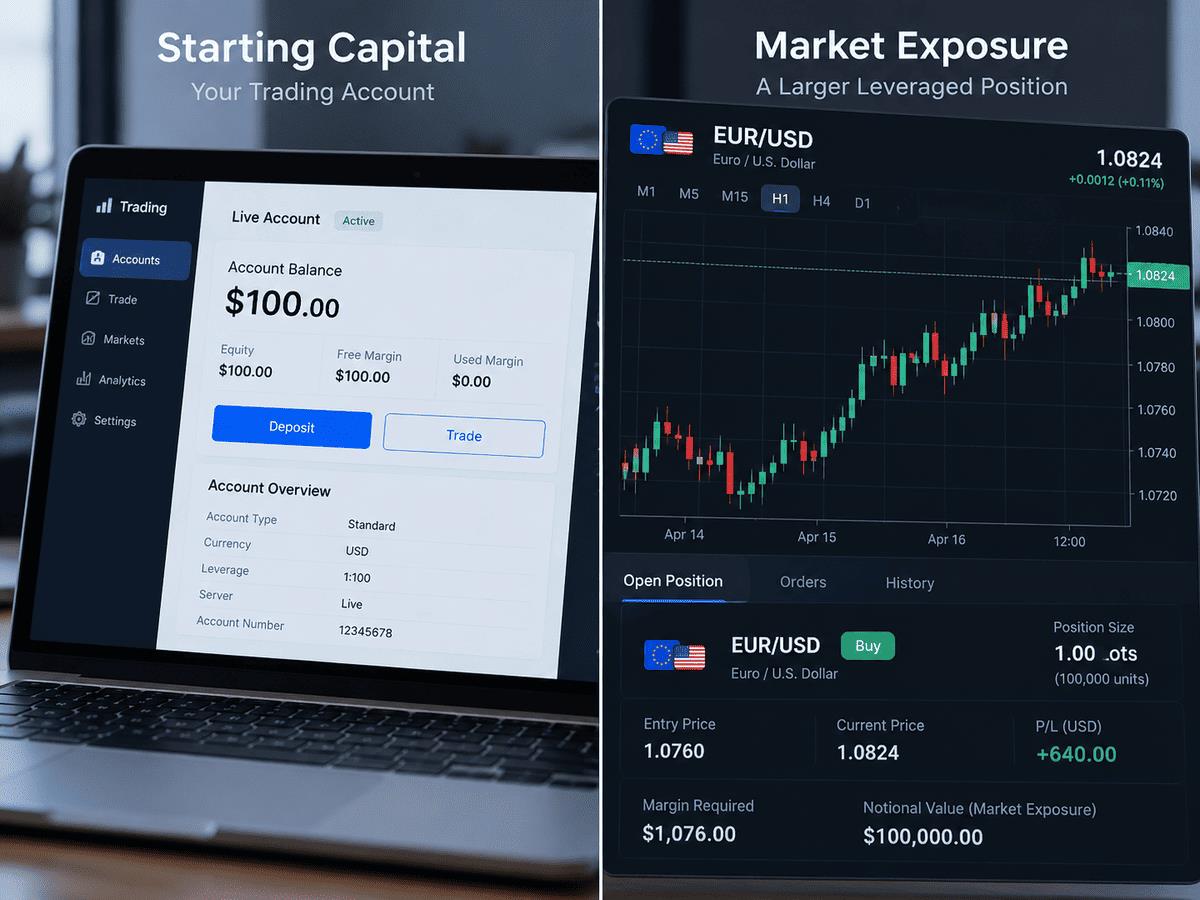
Beginners sometimes approach this question from the other direction and ask whether a relatively small balance is enough. For example, looking at whether $100 is enough to start forex trading quickly leads to questions about position size, margin, costs and risk rather than the deposit amount alone.
That is the more useful way to think about starting capital.
The amount in the account matters, but what you intend to do with it matters more.
Margin Determines How Much Capital a Trade Uses
Forex is commonly traded using margin.
Margin is the amount of money that must be available in your account to open and maintain a leveraged position. You gain exposure to a larger position without paying its full notional value upfront.
For example, if a position has a 2% margin requirement, opening a position worth $10,000 would require $200 of margin.
That does not mean the trade can only lose $200.
The gain or loss is based on the value of the position and how far the exchange rate moves. Leverage therefore magnifies both gains and losses.
This is one of the easier details for beginners to underestimate. A relatively small margin requirement can make a large position look affordable even when the resulting exposure is much greater than the trader intended.
Before opening a position, it is worth knowing both the margin required and the amount of money that would be gained or lost if the exchange rate moved by a given amount.
The Spread Is a Cost You See on Every Trade
When looking at a currency pair, you normally see two prices: the bid and the ask.
The difference between them is the spread.
Suppose EUR/USD has a bid price of 1.1700 and an ask price of 1.1702. The two-pip difference is the spread.
That gap matters because a newly opened trade has to overcome the spread before it becomes profitable, assuming everything else remains unchanged.
A small spread may not look particularly important on one trade. Repeat the process many times, however, and transaction costs begin to add up.
This means trading frequency matters.
Someone who opens and closes positions frequently may be more sensitive to spreads than someone who trades less often and holds positions for longer.
The lowest advertised spread also does not necessarily tell the whole story. Spreads can vary between currency pairs and may widen when liquidity falls or markets become more volatile.
Keeping Trades Open Can Have Another Cost
Some forex positions are opened and closed during the same trading day. Others remain open overnight.
That difference can matter because positions carried from one trading day into the next may be subject to rollover or financing adjustments.
The exact amount depends on factors such as the currency pair, whether the position is long or short, prevailing interest rates and the provider’s trading conditions.
That means a position can have a cost beyond the original spread simply because of how long it remains open.
For a short-term trade that closes the same day, overnight financing may never become relevant. For a position held over several days or weeks, it deserves more attention.
Before opening an account, check how these adjustments are calculated rather than assuming the spread represents the entire trading cost.
Position Size Can Matter More Than the Deposit
There is a temptation to think that a bigger trading account automatically makes trading safer.
It does not.
A trader who deposits $5,000 and immediately opens oversized positions could take considerably more market risk than someone with a $1,000 account using much smaller positions.
Consider a simplified example.
Trader A has $1,000 and opens a $5,000 position.
Trader B has $5,000 and opens a $100,000 position.
Trader B has five times as much money in the account, but 20 times the market exposure.
Looking only at their deposits would hide the more important difference.
This is why the question “How much should I deposit?” cannot really be separated from “How much am I planning to trade?”
Increasing the account balance does not fix excessive exposure. Sometimes the more relevant adjustment is reducing the position size.
Where Do Forex Bonuses Fit Into the Cost?
Promotional credit can make the starting-cost calculation a little less straightforward.
Forex promotions do not all work in the same way. Some require a trader to fund an account first, while others may provide limited trading credit without an initial deposit.
A forex no-deposit bonus, for example, generally refers to promotional credit that can be received without first depositing your own funds.
That does not necessarily make the credit equivalent to cash.
Eligibility rules may apply, and there may be restrictions on how promotional credit is used or withdrawn. Conditions can also determine what happens to the credit when money is removed from the account.
This is why the headline amount is only one part of any promotion.
Before accepting one, check whether a deposit is required, whether the promotional amount itself is withdrawable, whether profits are treated differently and what could cause the credit to be removed.
Most importantly, additional trading credit does not make the underlying market exposure safer. The value of a leveraged forex position can still move against you.
Losses Are Part of the Real Cost
Spreads and financing charges are relatively easy to identify because they can be expressed as numbers before a trade is placed.
Trading losses are less predictable.
A currency pair can move because of economic data, interest-rate expectations, central-bank decisions, political developments or changes in market sentiment. Sometimes several of those forces are working at once.
Leverage can then increase the financial impact of relatively small movements in the exchange rate.
US regulators warn that retail forex customers can lose all the money deposited for trading and, depending on the circumstances, may face losses beyond their initial deposit.
This changes how starting capital should be viewed.
Money used for leveraged forex trading should not be money required for rent, loan payments, emergency expenses or other essential financial obligations.
The amount you can technically deposit and the amount you can afford to put at risk are not necessarily the same.
Do Not Forget Deposits and Withdrawals
There is one more part of the cost equation worth checking before funding an account: moving money in and out.
Payment methods vary between providers. So can processing requirements, currency-conversion costs and withdrawal conditions.
Read those details before depositing rather than waiting until you eventually want to withdraw.
Check whether withdrawals normally have to return through the original funding method, whether account verification must be completed first and whether any processing costs could apply.
This may seem less important than spreads or leverage when you are opening the account.
It becomes much more interesting when you want your money back.
So How Much Does It Cost to Start?
There is no universal dollar amount.
The real cost of starting forex trading depends on several things working together: how much you deposit, the size of the positions you open, the margin required, the spreads you pay, how long positions remain open and whether those trades produce gains or losses.
Promotional credit can change the amount available for trading, but it does not remove those costs or risks.
Instead of starting with the question, “What is the smallest deposit I can make?” a more useful question may be, “How much exposure am I taking on, and what could that cost if the market moves against me?”
That number tells you far more about the money involved.