Core Pillars of Modern Digital Marketing Strategies
In today’s rapidly evolving digital landscape, dated marketing approaches simply won’t cut it. By October 2026, an effective digital marketing strategy is no longer a luxury; it’s essential for survival and growth. Consumer behaviors are constantly shifting, AI is reshaping search and personalization, and competition for online attention is fiercer than ever. Navigating these changes requires a clear, data-driven approach.
This comprehensive guide is designed to empower modern businesses like yours with the insights and strategies needed to thrive. We will explore the core pillars of digital marketing, from adapting to AI-driven search to leveraging owned media. We’ll also dive into building high-converting multi-channel ecosystems and the critical role of data infrastructure for continuous optimization.
Whether your goal is to enhance brand awareness, drive e-commerce sales, or focus on generating home service leads, these strategies are adaptable and proven to deliver results. Join us as we unpack the crucial elements for success in the dynamic digital world of 2026.
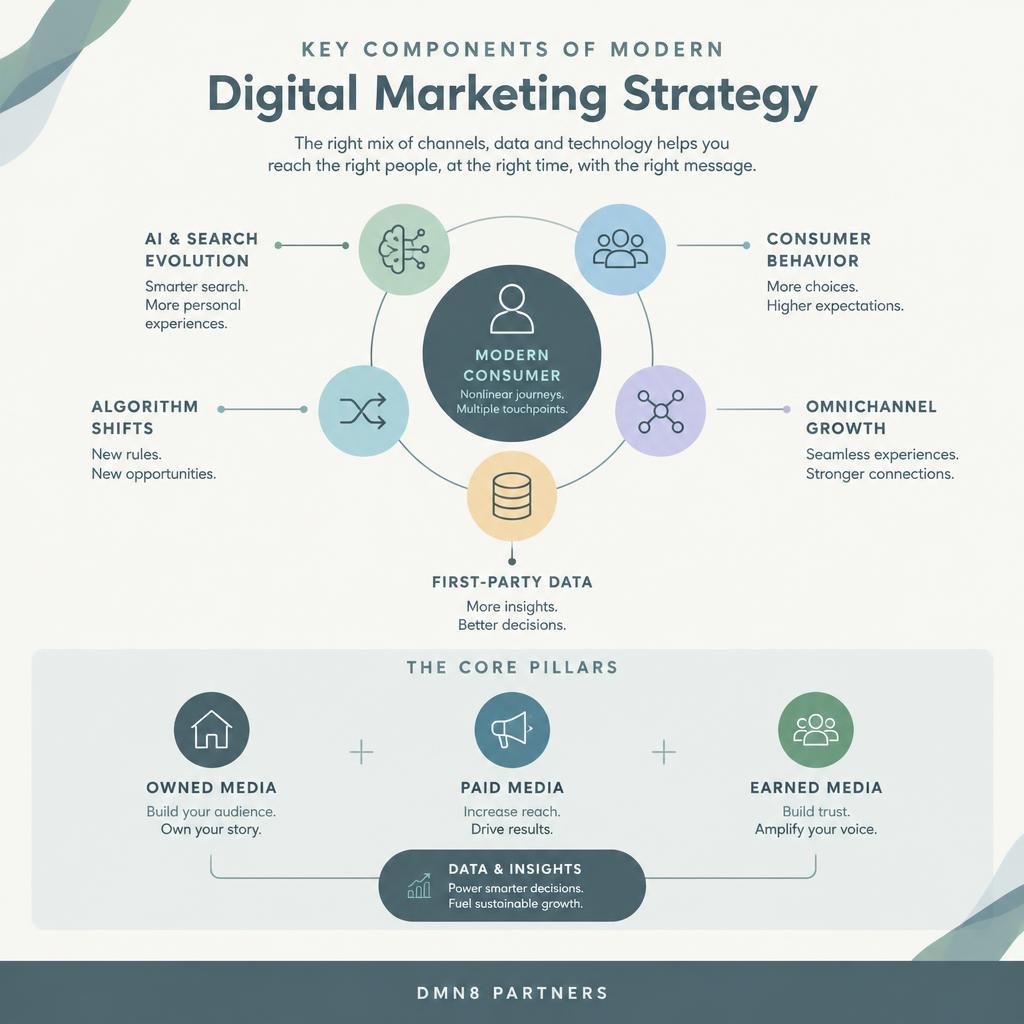
A robust digital marketing strategy in 2026 hinges on a balanced approach to owned, paid, and earned media, underpinned by a deep understanding of customer data, particularly zero-party data. These three pillars, when integrated effectively, create a powerful synergy that builds brand equity and drives sustainable growth.
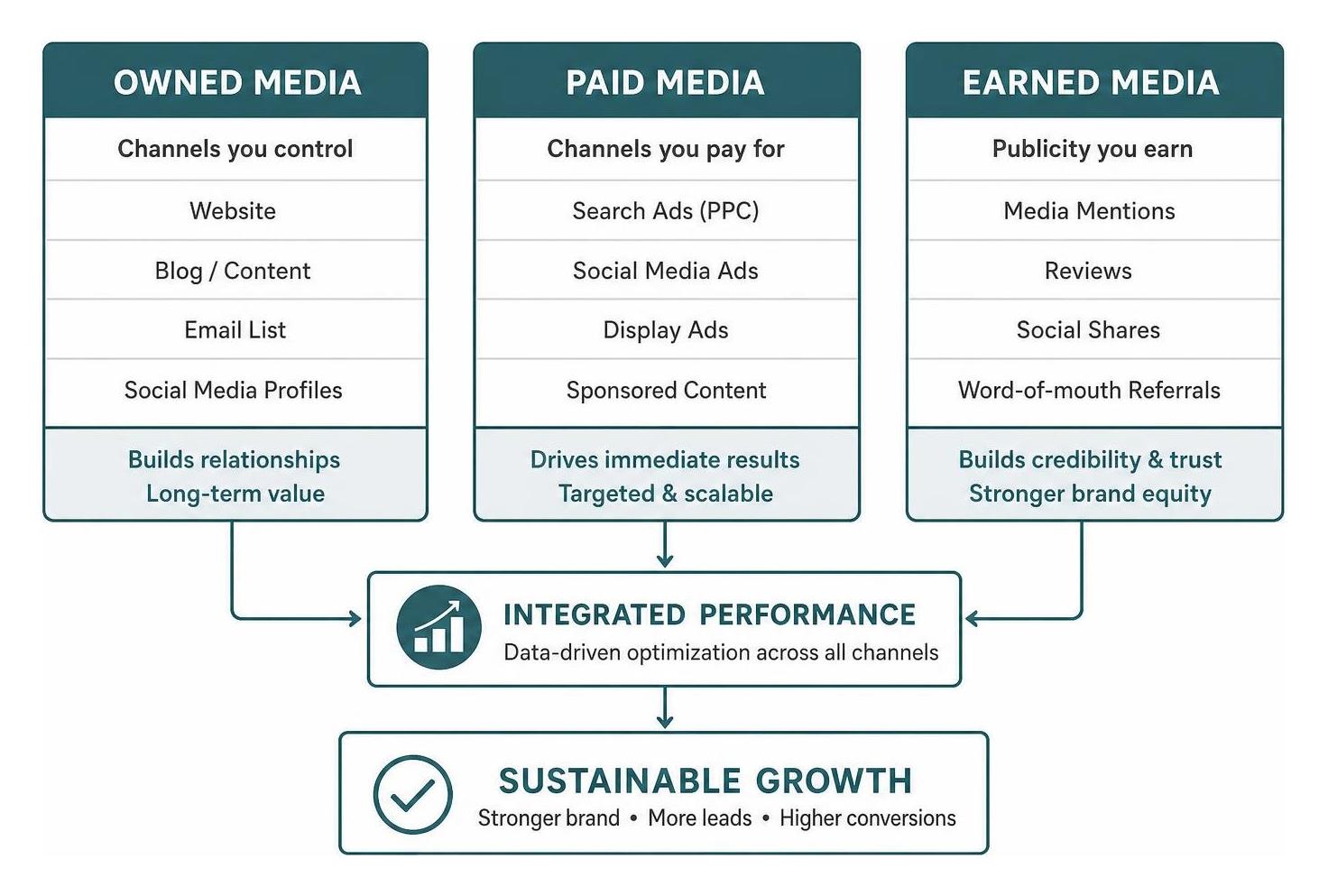
Owned Channels are assets your business directly controls, such as your website, blog, email lists, and social media profiles. These channels are crucial for building long-term relationships and housing valuable content. Email marketing, in particular, remains a powerhouse, delivering an impressive ROI of approximately $36 for every $1 spent, making it a channel you truly own and control, free from algorithm changes. Your website serves as your digital storefront, requiring continuous optimization for user experience, speed, and mobile responsiveness.
Paid Advertising encompasses any marketing effort for which you pay, including search engine ads (PPC), social media ads, display ads, and sponsored content. Paid channels offer immediate visibility, precise targeting capabilities, and scalability. They are excellent for generating quick leads, driving traffic to new content, or promoting specific offers. However, they require careful budget management and continuous optimization to ensure positive return on ad spend (ROAS).
Earned Media refers to publicity gained through promotional efforts other than paid advertising. This includes media mentions, positive reviews, social media shares, and word-of-mouth referrals. Earned media builds credibility and trust, often carrying more weight with consumers than paid messages. Cultivating strong relationships with customers and providing exceptional service are key to generating positive earned media.
Zero-Party Data, data willingly and proactively shared by customers, has become increasingly vital in a privacy-first world where third-party cookies are rapidly diminishing. This data, collected through surveys, preference centers, and interactive content, allows for hyper-personalization while respecting user privacy, fostering trust and deeper engagement. The effective integration and optimization of these three media types, combined with ethical data practices, are what build lasting brand equity in the competitive digital landscape.
Adapting Digital Marketing Strategies for AI-Driven Search
The evolution of search engines, particularly with the rise of AI overviews and generative AI responses, demands a significant shift in SEO strategies for 2026. Instead of merely optimizing for keywords, we must now optimize for intent, context, and the AI’s understanding of information.
AI overviews are fundamentally changing how users interact with search results. When AI directly answers queries, traditional click-through rates to websites can decrease. This necessitates a focus on providing comprehensive, authoritative, and structured answers within your content that AI can easily synthesize.
Semantic search is at the core of this shift. Search engines are no longer just matching keywords; they are understanding the meaning and context behind a user’s query. This means our content must address topics thoroughly, answer related questions, and demonstrate a deep understanding of the subject matter.
E-E-A-T (Experience, Expertise, Authoritativeness, Trustworthiness) has never been more critical. Google’s algorithms increasingly prioritize content from sources that demonstrate genuine experience and credibility. For businesses, this means showcasing the qualifications of your content creators, providing real-world examples, and building a strong reputation in your niche.
Conversational queries, often longer and more natural-sounding, are becoming more common, especially with voice search. Our keyword research must expand to include these long-tail, question-based phrases, and our content should be structured to answer them directly and concisely.
Structured data (Schema Markup) is essential for helping search engines and AI understand the context of your content. By tagging information like products, reviews, events, and FAQs, we provide clear signals that can lead to rich results and featured snippets, increasing visibility even in an AI-dominated SERP.
Building topical authority involves creating a comprehensive cluster of interconnected content around a core subject. This signals to search engines that your website is a go-to resource for that topic, enhancing your E-E-A-T and overall ranking potential.
Finally, technical SEO remains the bedrock. A fast, crawlable, and mobile-friendly website is non-negotiable. Without a solid technical foundation, even the most brilliant content and E-E-A-T signals may go unnoticed by search engine crawlers and AI systems.
Leveraging Owned Media and Automation Orchestration
In an era of shifting algorithms and increasing privacy concerns, owned media channels offer stability and direct access to your audience. When combined with sophisticated automation, they become incredibly powerful tools for engagement and retention.
Email marketing stands out as the most reliable owned channel. Unlike social media, your email list is an asset you fully control. It’s the perfect platform for nurturing leads, sharing valuable content, announcing promotions, and building a loyal customer base. The key is to provide consistent value, segment your audience effectively, and personalize your messages.
Beyond email, your website, blog, and even dedicated mobile apps serve as direct channels for communication and conversion. These platforms allow you to dictate the user experience, capture first-party data, and guide customers through their journey without third-party interference.
CRM segmentation is crucial for maximizing the impact of your owned media. By categorizing your audience based on demographics, purchase history, behavior, and preferences, you can deliver highly relevant content and offers. This level of personalization significantly boosts engagement and conversion rates.
Automated triggers are the engine of modern owned media strategies. These are pre-defined actions that fire based on specific user behaviors or timeframes. Examples include welcome sequences for new subscribers, abandoned cart reminders, post-purchase follow-ups, or re-engagement campaigns for inactive users. Automation orchestration synchronizes these triggers across various channels, ensuring a seamless and timely customer experience.
Effective automation is a cornerstone of customer retention. By proactively engaging customers with personalized content, exclusive offers, and helpful resources, businesses can significantly increase customer lifetime value (CLV). This approach shifts focus from constant acquisition to nurturing existing relationships, which is often more cost-effective.
Personalized messaging, driven by zero-party data and AI, is what sets leading brands apart. Whether it’s a dynamic website experience, a tailored email newsletter, or a custom product recommendation, delivering content that resonates with individual needs fosters a sense of connection and loyalty.
Building a High-Converting Multi-Channel Ecosystem

A truly effective digital marketing strategy in 2026 moves beyond isolated campaigns to create a cohesive, multi-channel ecosystem. This approach recognizes that customer journeys are non-linear and that consumers interact with brands across numerous touchpoints before making a purchase. Our goal is to build seamless conversion paths that guide prospects from initial awareness to loyal advocacy, leveraging audience segmentation and continuous creative testing to optimize every step of the full-funnel marketing journey.
Optimizing Digital Foundations and Web Conversion
Your website is the central hub of your digital ecosystem, and its performance directly impacts your marketing success. A poorly optimized site can negate even the most effective marketing campaigns.
Site architecture must be logical and intuitive, making it easy for both users and search engine crawlers to navigate. A flat hierarchy, clear categories, and well-structured internal linking improve user experience and distribute “link juice” effectively throughout your site, boosting SEO.
Core Web Vitals – including Largest Contentful Paint (LCP), Cumulative Layout Shift (CLS), and Interaction to Next Paint (INP) – are crucial metrics for user experience and search ranking. Prioritizing these technical aspects ensures your site loads quickly, is visually stable, and is highly interactive, reducing bounce rates and improving engagement.
Given that mobile devices account for over 58% of global web traffic, mobile responsiveness is non-negotiable. Your website must provide a flawless experience across all screen sizes, from smartphones to desktops. This isn’t just about aesthetics; Google’s mobile-first indexing means your mobile site is the primary version considered for ranking.
All these foundational elements contribute to your conversion rate. A fast, user-friendly, and mobile-optimized website is more likely to convert visitors into leads or customers. If you’re looking to build or revamp your online presence to meet these exacting standards, investing in custom web design services can provide the robust, high-performing platform necessary for 2026 and beyond. A well-designed site not only looks good but also functions as a powerful conversion engine, enhancing the overall user experience and supporting all your digital marketing efforts.
Scaling Targeted Paid Media and Local Lead Acquisition
Paid media, when executed strategically, can deliver immediate and measurable results, especially for businesses focused on lead generation or local services. The key is precision targeting and continuous optimization.
Understanding search intent is paramount. For paid search campaigns, this means matching your ads to exactly what users are looking for. If someone searches for “emergency plumber near me,” your ad should directly address that need, leading them to a relevant landing page.
Platforms like Google Ads and Meta Ads (Facebook & Instagram) are powerful tools for paid search and social advertising. For B2B lead generation on Meta, the 2026 framework emphasizes aligning signal relevance, creative, and bidding strategies, using targeted lead ad formats, and structured creative testing processes.
Geo-targeting allows you to focus your ad spend on specific geographic areas, which is invaluable for local businesses. This can be as broad as a city or as narrow as a few blocks, ensuring your ads reach the most relevant local audience.
Local SEO complements paid efforts by optimizing your online presence for local search results. This includes maintaining an accurate and optimized Google Business Profile, securing local citations, and generating local reviews. For businesses like home service providers, local SEO is critical for attracting nearby customers. If your business relies on generating home service leads, a combination of targeted paid media and robust local SEO is essential for driving consistent inquiries and bookings.
Bidding automation, often powered by AI, helps optimize your ad spend in real-time. These systems analyze vast amounts of data to adjust bids, ensuring your ads are shown to the most valuable audiences at the most opportune moments, maximizing your ROAS.
Fostering Community Loyalty and Brand Advocacy
In a crowded digital space, building genuine connections and fostering a sense of community around your brand can be a powerful differentiator. This moves beyond traditional marketing to cultivate loyalty and turn customers into advocates.
Micro-communities, hosted on platforms like Slack, Discord, or private forums, provide exclusive spaces for customers to connect with each other and with your brand. These communities can be used for beta testing, customer support, sharing tips, and gathering valuable feedback, fostering a sense of belonging and direct engagement.
Social proof, in the form of customer reviews, testimonials, and user-generated content (UGC), is more influential than ever. Encouraging satisfied customers to share their experiences builds trust with potential new customers. Micro-influencers and nano-influencers, with their smaller but highly engaged audiences, often drive disproportionately high engagement compared to larger accounts.
For brands looking to build deeper connections based on shared values, mission-driven community engagement can be a transformative strategy. This involves actively involving your community in your brand’s purpose, whether through social initiatives, co-creation, or shared experiences, creating a powerful sense of collective identity and loyalty.
Creator partnerships, especially long-term collaborations with micro- and nano-influencers, can extend your reach and authenticity. These partnerships feel more genuine to audiences than traditional celebrity endorsements, leading to higher engagement and conversion rates.
The goal is to cultivate customer advocacy. When customers are genuinely satisfied and feel connected to your brand, they become your most effective marketers, sharing their positive experiences and recommending your products or services to their networks. This organic growth is invaluable and highly sustainable.
Data Infrastructure, Attribution, and Continuous Optimization

In the complex digital landscape of 2026, marketing success is inextricably linked to data. Without a robust data infrastructure, accurate attribution, and a commitment to continuous optimization, businesses risk misallocating resources and missing critical growth opportunities. Unified data governance, automated pipelines, and sophisticated measurement frameworks are no longer optional—they are essential for driving speed and ROI.
Deploying Multi-Touch Attribution and Revenue Tracking
The days of relying solely on last-click attribution are over. With non-linear customer journeys spanning multiple channels, multi-touch attribution models are crucial for understanding the true contribution of each marketing touchpoint to a conversion. These models, which distribute credit across various interactions, provide a more accurate picture of your marketing effectiveness.
Implementing a consistent UTM taxonomy across all your campaigns is foundational for accurate tracking. These parameters appended to URLs allow you to identify the source, medium, campaign, and content that drove traffic, ensuring that data flowing into your analytics and CRM systems is clean and actionable.
CRM integration is vital for connecting marketing data with sales outcomes. By linking marketing interactions to customer records in your CRM, you can track the entire customer journey, from initial touchpoint to closed-won deal, enabling precise CAC and CLV calculations. This also allows for the tracking of offline conversions, such as phone calls or in-store visits, that originated from digital campaigns.
Calculating CAC (Customer Acquisition Cost) accurately requires integrating all marketing spend (ads, software, headcount, agency fees) and dividing it by the number of new customers acquired. Similarly, ROAS (Return on Ad Spend) analysis helps you understand the direct revenue generated by your paid campaigns, guiding budget allocation decisions. By tracking these pipeline metrics and linking them to revenue, we ensure our marketing efforts are directly contributing to the bottom line.
Implementing Iterative Testing and Agile Execution
The digital world moves fast, and our marketing strategies must be equally agile. Continuous iterative testing and a commitment to rapid execution are paramount for staying competitive and maximizing performance.
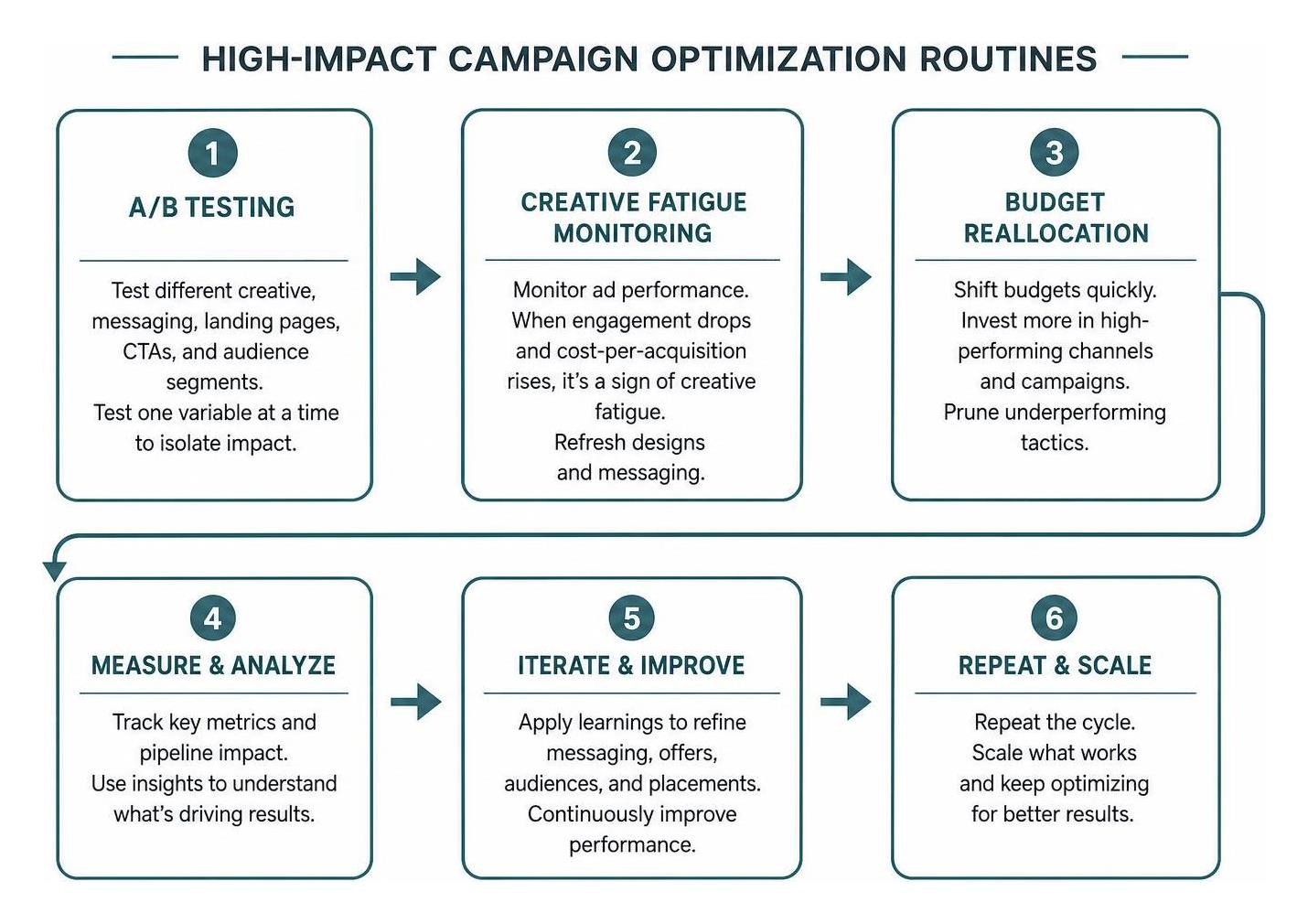
Here are some high-impact campaign optimization routines we regularly implement:
- A/B Testing: Regularly test different creative, messaging, landing page layouts, calls to action, and audience segments. Test one variable at a time to isolate impact.
- Creative Fatigue Monitoring: Keep a close eye on ad performance. When engagement drops and cost-per-acquisition rises, it’s a clear sign of creative fatigue, requiring fresh designs and messaging.
- Budget Reallocation: Be prepared to shift budgets quickly. If one channel or campaign is significantly outperforming others, reallocate resources to capitalize on its success. Conversely, prune underperforming tactics.
- Anomaly Detection: Implement automated alerts for unusual spikes or drops in performance. This allows for rapid investigation and correction, preventing minor issues from becoming major problems.
- 70-20-10 Rule: A common budget allocation strategy where 70% goes to proven, high-performing channels, 20% to experimental but promising initiatives, and 10% to entirely new or emerging channels. This balances stability with innovation.
This agile approach, often described as “production over perfection,” prioritizes speed and learning from real-world data. Waiting for perfect data kills agility; acting on 80% confidence and iterating quickly often yields faster, more impactful results.
Frequently Asked Questions About Digital Marketing
Navigating the complexities of digital marketing often raises fundamental questions. Here, we address some common queries that businesses face when developing and implementing their strategies.
What is the difference between a digital marketing strategy and a marketing plan?
While often used interchangeably, a digital marketing strategy and a marketing plan serve distinct purposes. The strategy defines the overarching strategic vision: the long-term goals, the target audience, and the foundational channels chosen to achieve business objectives. It answers the “why” and “what” – why we’re focusing on certain channels and what we aim to achieve.
A marketing plan, on the other hand, is the operational roadmap. It details the tactical “how” and “when” of execution. This includes specific campaign schedules, content calendars, resource allocation (including budget, team assignments, and tools), and daily actions. The plan translates the strategic vision into actionable steps, complete with specific KPI targets for each initiative. For example, a strategy might be “increase brand awareness through content marketing,” while the plan would detail the types of content, publishing schedule, distribution channels, and budget for that content.
How should businesses allocate budget across channels?
Budget allocation is highly dependent on industry, business size, growth stage, and specific revenue targets. However, a balanced approach typically involves a mix of channels. For many businesses, particularly those in B2B and retail, a significant portion of the budget is allocated to paid media to maintain consistent visibility and drive immediate results.
We recommend considering a channel maturity model:
- Proven Channels: Allocate the largest portion of your budget (e.g., 70% using the 70-20-10 rule) to channels that have consistently delivered strong ROI.
- Paid Experimentation: Reserve a portion (e.g., 20%) for testing new approaches within existing channels or scaling promising but not yet fully proven initiatives.
- Owned Media: Continuously invest in your website, content, and email list. While the direct cost may seem lower, the long-term ROI is substantial.
- Testing Reserves: A small percentage (e.g., 10%) should be dedicated to exploring entirely new or emerging channels and technologies.
Digital marketing costs can vary widely. For comprehensive digital marketing services encompassing strategy, execution, and reporting, pricing ranges from $750 to $2500 monthly, depending on the scope and complexity of the campaigns. This investment should always be viewed in terms of the potential ROI it can generate.
How Often Should Businesses Refresh Digital Marketing Strategies?
While the core strategic vision might remain stable for a year or more, the tactical implementation and specific channel strategies require frequent review and adaptation. We recommend quarterly reviews as a minimum to assess performance and make necessary adjustments.
Several factors necessitate this agility:
- Algorithm Changes: Search engines and social media platforms constantly update their algorithms, which can significantly impact visibility and reach.
- Market Shifts: Consumer behavior, competitor activities, and economic conditions are always evolving.
- Performance Auditing: Regular analysis of your KPIs will reveal what’s working and what isn’t, guiding where to double down or pivot.
- Emerging Technologies: New tools, platforms, and AI capabilities emerge rapidly, offering new opportunities for engagement and efficiency.
For instance, the rapid changes in AI-driven search, like generative AI summaries, mean that SEO strategies must be agile enough to adapt to these shifts, perhaps even on a monthly basis for critical keywords. A flexible strategy that embraces continuous iteration is far more effective than a rigid plan in the dynamic digital landscape of 2026.
Conclusion
In the digital world of October 2026, a well-defined and agile digital marketing strategy is the bedrock of business success. We’ve explored how a balanced approach to owned, paid, and earned media, coupled with a deep understanding of AI-driven search and the power of automation, can create a high-converting multi-channel ecosystem. From optimizing your digital foundations with custom web design services to mastering generating home service leads through targeted paid media and local SEO, every element plays a crucial role. Furthermore, fostering genuine connections through mission-driven community engagement builds invaluable brand loyalty and advocacy.
The emphasis on robust data infrastructure, multi-touch attribution, and continuous iterative testing ensures that every marketing dollar is spent wisely, driving measurable revenue impact and sustainable growth. By embracing this strategic alignment and committing to an actionable roadmap, businesses can confidently navigate the evolving digital landscape, turning challenges into opportunities for unprecedented success.