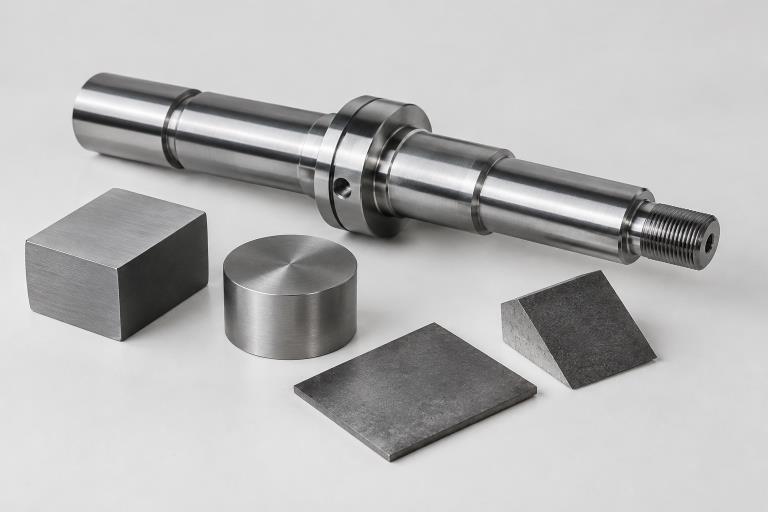
Choosing alloy steel is not a matter of selecting the strongest grade on a data sheet. The right choice depends on what the part must do, how it will be made, and how it may eventually fail. For a useful starting point on available alloy steel options and common grades, learn more here.
A shaft carrying steady torque in a clean indoor setting may need a very different material condition than a similar shaft exposed to impact, water, abrasive dust, and frequent starts and stops. Early material decisions affect reliability, manufacturing time, maintenance needs, and replacement cost.
Why Material Selection Matters
Material selection should begin before detailed design or purchasing. A grade that performs well in one application can be a poor fit in another because strength, toughness, hardness, corrosion resistance, and machinability do not move together automatically. Increasing hardness, for example, can improve resistance to surface indentation while reducing the margin for impact damage if toughness is not adequate.
Premature wear, cracking, distortion, and difficult machining are often symptoms of a mismatch between service conditions and the selected material. A practical choice balances performance with the actual geometry, required finish, manufacturing route, inspection plan, and availability of suitable stock.
Start With Service Conditions
Use the working environment as the first filter. Define normal operation, but also identify unusual events such as jams, overloads, emergency stops, temperature spikes, or exposure to cleaning chemicals. These conditions establish what the material must reliably withstand.
Service-Condition Checklist
- Is the load static, changing, reversing, or applied as a sudden impact?
- Will vibration, misalignment, or repeated starts and stops occur?
- What are the lowest and highest operating temperatures?
- Will the part contact moisture, salt, chemicals, lubricants, or abrasive particles?
- What service life is expected, and can the part be inspected or replaced easily?
- What size, shape, dimensional tolerance, and surface finish are required?
Key Properties To Compare
Each material property answers a different engineering question. Yield strength indicates the stress level at which permanent deformation begins. Tensile strength describes resistance to fracture in a pulling test. Hardness helps indicate resistance to indentation and some forms of wear, while toughness describes the ability to absorb energy before fracturing.
Ductility matters when a part must bend, stretch, or be formed without cracking. Fatigue resistance is important when loads repeat over time. Machinability affects cutting speed, tool wear, surface quality, and production cost. No single number replaces a complete review of the part’s operating demands.
Load, Fatigue, And Fracture Risk
Repeated loading can cause damage even when each individual load seems moderate. In material fatigue, small cracks can initiate and grow under cyclic stress until the remaining section can no longer carry the load. This is why a successful one-time proof test does not necessarily establish a long service life.
Pay close attention to stress raisers such as sharp internal corners, threads, keyways, holes, weld toes, and surface scratches. These features can concentrate stress and become likely crack-initiation points. For critical components, use realistic load histories, engineering analysis, prototype testing, or focused laboratory testing rather than relying only on a maximum-load estimate.
The Role Of Heat Treatment
The same alloy can provide very different results after different thermal processes. Heat treatment changes a steel’s microstructure through controlled heating and cooling, which can alter hardness, strength, toughness, residual stress, and dimensional stability.
- Annealing is commonly used to soften steel and improve workability.
- Quenching can increase hardness by rapidly cooling suitable steels from the proper temperature range.
- Tempering is used after hardening to reduce brittleness and adjust the final property balance.
Part thickness, geometry, furnace control, cooling rate, and fixturing all influence the result. A heat-treatment specification should therefore define the desired material condition, hardness range, and any distortion limits, not simply state that the part must be “hardened.”
Wear, Corrosion, And Surface Damage
Wear and corrosion are separate problems that can interact. Abrasive wear occurs when hard particles remove material. Adhesive wear can occur when sliding surfaces transfer material between one another. Impact wear develops under repeated blows. Corrosion may appear as general surface attack, localized pitting, or cracking promoted by a combination of stress and a corrosive environment.
Harder steel is not automatically the best answer. Surface finish, lubrication, alignment, coatings, drainage, sealing, and routine inspection may have as much influence on service life as bulk hardness. Consider where moisture can become trapped, especially at joints, threads, interfaces, and crevices.
Manufacturing And Machining Factors
A sound technical choice must also be practical to produce. Confirm that the grade is available in the required bar, plate, or forging size and that it can meet tolerance and finish requirements. Review machining time, tool wear, welding procedures, heat-affected zones, forming limits, and the need for stress relief or final heat treatment.
For example, a higher-strength grade may reduce section size but require slower cutting, specialized tooling, or additional processing. The initial purchase price is only one part of the total cost. Material certificates, heat numbers, inspection records, and clear traceability requirements are especially important when a part is safety-critical or difficult to replace.
A Practical Selection Process
- Define the job: Record loads, motion, temperature, environment, geometry, and target service life.
- Rank the main risks: Decide whether fatigue, impact, wear, corrosion, or distortion is the leading concern.
- Set measurable requirements: Specify needed strength, hardness, toughness, tolerance, finish, and documentation.
- Compare a short list: Evaluate a few suitable alloy families instead of selecting from every available grade.
- Confirm processing: Check machining, welding, forming, and heat-treatment requirements before release.
- Validate the decision: Use prototypes, analysis, or testing when failure would create high cost or risk.
Common Selection Mistakes
- Choosing by tensile strength alone.
- Ignoring cyclic loads, vibration, and stress concentrations.
- Assuming a harder surface resolves every wear mechanism.
- Overlooking corrosion at joints and moisture-trapping features.
- Failing to plan for heat-treatment distortion.
- Skipping checks for stock size, material condition, and traceability.
- Replacing a failed part without determining the original failure mode.
Conclusion
The best alloy steel choice begins with the part’s real job. Match measurable service demands with verified material data, suitable processing, and realistic validation. When load, heat, wear, corrosion, fatigue, manufacturing, and total cost are considered together, teams are far more likely to select a material that performs reliably throughout its intended service life.