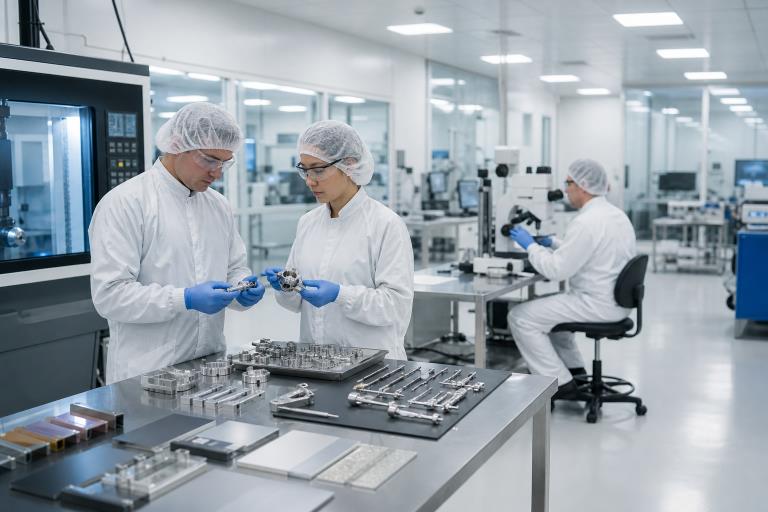
The selection of medical-grade metal affects far more than a part’s strength. It influences device size, weight, surface finish, manufacturing method, sterilization durability, validation requirements, and long-term reliability. Teams that involve Viant metal fabrication capabilities early can better connect material decisions with realistic production requirements.
The best metal is not the strongest or most familiar alloy. It is the material that fits the device’s complete use case, including patient contact, mechanical loads, cleaning exposure, expected service life, geometry, and manufacturing process. A metal suitable for a reusable surgical instrument may be unsuitable for a permanent implant or a flexible catheter component.
Define The Device Requirements First
Before comparing alloys, translate the device concept into a short list of requirements. Identify expected loads, stiffness or flexibility needs, operating temperatures, critical tolerances, intended service life, anticipated production volume, and cost boundaries. Also, document whether the component will contact tissue, blood, drugs, cleaning chemicals, or other device materials.
Separate must-have properties from nice-to-have properties. For example, a component may require corrosion resistance and repeatable thin-wall forming, while very high strength may be optional. This distinction can prevent overengineering and reduce the risk of choosing an expensive alloy for performance that the device does not need.
Common Metals Used In Medical Devices
Several metal families are commonly considered for medical devices, but none is automatically the right answer. Grade, heat treatment, surface condition, and processing history can be as important as the broad material category.
- Stainless steel:A practical choice for many instruments, guide components, and structural parts because it can combine strength, corrosion resistance, and manufacturing flexibility.
- Titanium and titanium alloys:Often evaluated when low weight, high strength, and tissue compatibility are especially important.
- Cobalt-chromium alloys:Useful for applications that demand high mechanical strength and wear resistance.
- Nitinol:Valuable for components that depend on superelasticity or shape-memory behavior, such as certain minimally invasive device features.
- Tantalum and specialty alloys:Considered for narrower applications where specific biological, mechanical, or imaging characteristics are required.
Check Biocompatibility And Chemical Safety
Biocompatibility should be evaluated for the finished device, not only for the incoming metal bar, tube, or sheet. Machining fluids, welds, coatings, passivation, polishing compounds, residues, and sterilization can all affect the final risk profile. The FDA’s risk-based biological evaluation guidance helps manufacturers consider device contact, material chemistry, and the final finished condition.
Contact type and duration matter. A temporary instrument and a long-term implant may use the same metal family. Yet the required evidence can differ substantially because the exposure conditions, duration, and potential consequences vary.
Match The Metal To The Manufacturing Process
Material selection and process selection should happen together. An alloy can meet the mechanical target but still create problems during machining, laser cutting, forming, welding, grinding, or finishing. Early process reviews should ask whether the metal can hold shape after forming, maintain thin walls, avoid burrs or cracking, and scale from prototypes to production.
Joining and finishing deserve special attention. Welding may alter hardness, grain structure, or corrosion performance near the joint. Likewise, a required surface finish must be consistently achievable and support cleaning, assembly, inspection, and clinical use.
Account For Sterilization And Cleaning
Repeated autoclave cycles, chemical cleaning, radiation, and low-temperature sterilization can expose weaknesses in coatings, welds, polished surfaces, and mixed-metal assemblies. Test representative finished parts through the expected sterilization and cleaning conditions rather than relying on raw material assumptions.
Useful before-and-after checks include visual surface changes, dimensional shifts, changes in hardness or strength, corrosion behavior, joint integrity, cleanliness, and residue levels. For reusable devices, cycle counts should reflect realistic clinical use and reprocessing expectations.
Plan For Corrosion, Wear, And Fatigue
Corrosion risk depends on the full assembly, not simply the alloy name. Body fluids, cleaning agents, friction, temperature, trapped moisture, scratches, and contact with another metal can all influence performance. Understanding common forms of corrosion can help teams identify design features that deserve focused testing.
- Crevices that retain moisture or cleaning chemicals
- Dissimilar-metal connections that may create galvanic effects
- Repeated bending in thin wire, tubing, or spring features
- High-friction contact points that increase wear debris
- Damaged passivation layers and surface scratches
- Weld zones with locally altered material properties
Use Design For Manufacturability Reviews
A design-for-manufacturability review can prevent material issues from becoming late-stage production problems. Include engineering, quality, regulatory, manufacturing, and clinical-use perspectives. Review feature size, wall thickness, tolerance stack-up, tool access, fixturing, weld access, surface finish, cleaning needs, packaging, and inspection methods for critical features.
Sometimes a modest change in geometry improves yield, repeatability, and inspection access more effectively than switching to a more costly alloy. The objective is a design that performs as intended and can be produced consistently.
Build A Clear Testing Plan
Each material claim should connect to a measurable test. A complete plan may include material certification and chemical composition review, dimensional inspection, tensile or hardness testing, fatigue testing, surface roughness and cleanliness checks, corrosion and wear evaluation, weld inspection, biological evaluation, and sterilization compatibility.
Test parts made with normal or production-representative processes whenever possible. Prototype data may not predict full-scale results if tooling, suppliers, equipment settings, or finishing methods change.
Medical Device Metal Selection Checklist
- Define intended body contact and duration.
- Document strength, stiffness, fatigue, wear, and corrosion targets.
- Review risks across the full assembly, including joints and dissimilar metals.
- Confirm that the planned equipment can process and finish the selected metal.
- Evaluate cleaning and sterilization from the start.
- Qualify suppliers, lot controls, and incoming material documentation.
- Validate the finished device under representative use conditions.
- Review alternate materials or sources to support supply continuity.
Common Questions About Medical Device Metals
What Is The Best Metal For A Medical Device?
There is no single best choice. The right material depends on contact conditions, loading, flexibility, corrosion exposure, manufacturing method, sterilization process, and service life.
Is Titanium Always The Safest Choice?
No. Titanium can provide important benefits, but grade selection, surface condition, processing controls, and finished-device evaluation still matter.
Why Does Surface Finish Matter?
Roughness, scratches, residues, and surface treatments can influence cleaning, friction, wear, corrosion resistance, and biological response.
When Should Material Testing Begin?
Testing should begin during design definition and expand whenever the material, geometry, manufacturing process, finish, or sterilization method changes.
Final Takeaway
Medical-device metal selection is a system decision. The strongest approach integrates clinical use, materials science, design, manufacturing, validation, and supply planning from the outset. Teams can reduce costly surprises by treating the metal and the manufacturing process as a single, integrated design problem.