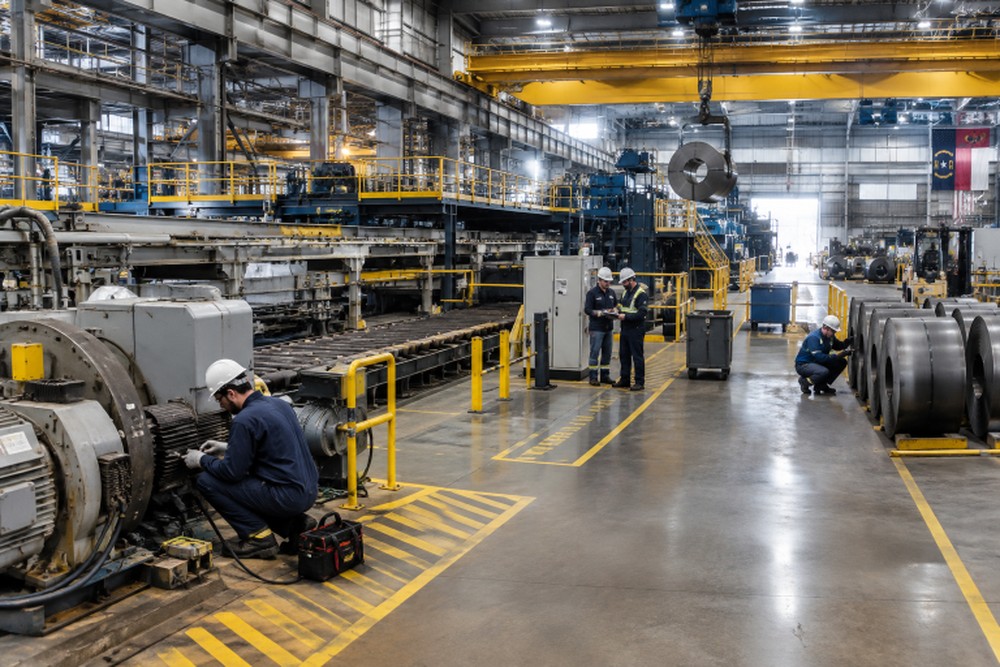
Key Takeaways
- Safe steel plant maintenance protects employees, equipment, and production schedules simultaneously.
- Heat, moving loads, stored energy, dust, noise, and traffic each require specific controls.
- Planned inspections can reduce rushed repairs and help teams identify equipment problems earlier.
- Engineering controls and sound job planning should come before reliance on personal protective equipment.
- Simple maintenance records can reveal repeat failures, training needs, and weak handoff practices.
North Carolina steel and metal operations face demanding conditions, from hot and humid summer weather to heavy material movement and time-sensitive production work. Whether a facility is located near Charlotte, in the Triad, or closer to the coast, maintenance teams need a practical system that makes safe work part of daily reliability planning.
Working with an iron and steel industry supplier in North Carolina can help maintenance departments prepare for routine repairs, planned shutdowns, and equipment needs. Still, the strongest maintenance program begins inside the plant, with clear hazard recognition, disciplined procedures, and communication between operators, technicians, supervisors, and contractors.
Why Steel Plant Maintenance Needs a Clear Plan
Steel facilities combine high temperatures, rotating equipment, sharp material edges, cranes, pressurized systems, welding, and large components. When a repair is delayed until a failure becomes urgent, workers may have less time to isolate equipment, gather the right lifting tools, or review changing conditions around the job site.
For example, an unusual bearing noise may appear minor during a busy shift. If it is not documented and inspected, the bearing can deteriorate until a larger failure causes a conveyor, fan, roll line, or other critical asset to stop. The emergency repair then creates more pressure on everyone involved. Reliable maintenance is not only about fixing equipment quickly. It is about controlling risk before the repair becomes urgent.
Map Hazards Before Work Begins
A pre-job hazard map gives the crew a shared view of what can go wrong and how the work will be controlled. It should be completed for both routine tasks and complex shutdown work, especially when the scope, location, or conditions have changed.
- Identify the equipment, process area, and exact task.
- List all energy sources, including electrical, hydraulic, pneumatic, mechanical, thermal, and gravitational energy.
- Note nearby exposure risks such as hot surfaces, dust, fumes, vehicle traffic, cranes, elevated work, and restricted access.
- Determine who may be exposed, including adjacent crews and contractors.
- Assign controls before approving the work order.
Supervisor Pre-Job Checklist
- Has the equipment been isolated and verified safe for work?
- Are access routes, escape paths, and work areas clear?
- Are slings, hooks, clamps, and lifting devices suitable for the load?
- Is ventilation adequate for welding, cutting, cleaning, or confined work?
- Does every crew member understand the emergency communication plan?
Use the Hierarchy of Controls
The hierarchy of controls is useful because it prioritizes reducing hazards at their source. Personal protective equipment remains important, but it should not be the only barrier between a worker and a serious hazard.
- Elimination: Remove an unnecessary hazardous task or exposure.
- Substitution: Choose a safer tool, material, or work method where practical.
- Engineering controls: Use guarding, barriers, local exhaust ventilation, remote tools, or lifting aids.
- Administrative controls: Improve permits, scheduling, training, work instructions, and job rotation.
- PPE: Select, maintain, and use protective equipment appropriate to the remaining risk.
Control Heat During Maintenance Work
Heat exposure can come from furnaces, hot metal, radiant heat, enclosed spaces, physical exertion, and protective clothing. North Carolina summer humidity can make it harder for the body to cool itself, particularly during outdoor work, roof work, or maintenance near hot processes.
Written job plans should account for heat before a worker becomes ill. Crews can measure conditions in the work area, schedule strenuous work during cooler periods when possible, provide drinking water and recovery areas, and use shielding, ventilation, fans, or remote tools to reduce exposure. Workers who are new, returning after time away, or not acclimatized to the conditions may need additional monitoring. Dizziness, confusion, weakness, cramps, and unusual fatigue should be reported immediately.
Make Lockout, Tagout, and Stored-Energy Checks Routine
Equipment that has stopped moving may still contain dangerous energy. Electrical circuits, hydraulic pressure, compressed air, gravity, rotating parts, steam, springs, and trapped process material all require attention before maintenance begins.
- Identify all energy sources associated with the task.
- Shut down the equipment using the approved procedure.
- Apply locks and tags to the designated isolation points.
- Release, restrain, block, or otherwise control stored energy.
- Verify that the equipment is in a zero-energy state before work begins.
- Inspect the area and clear personnel before restoring service.
Build an Inspection and Maintenance Cycle
A balanced program combines operator observations, scheduled maintenance, condition checks, and failure reviews. Operators can report leaks, vibration, unusual noise, odors, overheating, and visible damage. Technicians can then use planned tasks for lubrication, alignment, cleaning, tightening, inspection, and replacement before a defect grows into a production interruption.
Maintenance leaders should track a small set of useful measures rather than collecting data that nobody reviews. Good examples include planned work versus emergency work, repeat failures by asset, average repair time, inspection completion rates, maintenance-related near misses, and recurring delays due to missing parts or tools.
Improve Heavy Lifts and Material Handling
Coils, plates, beams, motors, gearboxes, and large tooling require careful lift planning. Before a lift, confirm the load weight and center of gravity, inspect lifting equipment, verify rated capacity, establish clear signals, and keep workers out of suspended-load paths. Traffic control also matters when cranes, forklifts, mobile equipment, and pedestrians share limited space.
A five-minute pre-lift discussion can prevent a far longer shutdown. If visibility drops, site conditions change, a load appears unstable, or the crew cannot confirm the lift plan, the correct response is to stop and reassess.
Use Data Without Losing Human Judgment
Digital work orders, inspection photos, temperature readings, vibration trends, and equipment histories can make maintenance decisions more consistent. The most useful records explain what failed, what conditions were observed, what repair was completed, and whether similar equipment should be checked.
Alerts should support trained workers, not replace field verification. A small number of accurate readings that lead to action is more valuable than a large volume of unreviewed notifications.
Strengthen Training and Shift Handoffs
Shift changes can create gaps when unfinished repairs, isolation points, unusual equipment readings, or temporary controls are not clearly communicated. A basic handoff should state what was completed, what remains open, which hazards are still present, what parts are needed, and what abnormal conditions were observed.
Task-based training should regularly cover energy isolation, heat response, confined-space entry, lifting safety, respiratory protection, and emergency communication. Short practical refreshers are often more useful than broad presentations disconnected from actual plant work.
Create a 30-Day Improvement Plan
- Days 1 to 5: Review recent incidents, near misses, repeat failures, and emergency work.
- Days 6 to 10: Walk high-risk maintenance areas with operators and technicians.
- Days 11 to 15: Select three hazards that can be reduced through equipment or work-practice changes.
- Days 16 to 20: Update job plans, inspection sheets, energy-control steps, and handoff forms.
- Days 21 to 25: Train affected employees and test the revised process in the field.
- Days 26 to 30: Review results, correct weak points, and set the next improvement target.
Conclusion
Safer maintenance is not a one-time purchase or annual training event. For North Carolina steel facilities, it is a daily system of hazard checks, reliable equipment care, clear records, practical training, and worker feedback. When safety decisions and maintenance planning support each other, plants can reduce avoidable exposure while improving control over downtime and production reliability.