Clear aligners have quietly rewritten what it means to straighten your teeth. No brackets to snag your cheek, no monthly tightening sessions, and no obvious metal smile staring back at you in photos. Yet the explosion of brands on the market makes it genuinely hard to figure out which system is worth your money and, more importantly, your trust.
The single most important distinction you need to understand before reading any list like this one is the difference between orthodontist-prescribed systems and direct-to-consumer mail-order kits. There are two fundamentally different categories of clear aligner product, and understanding that difference matters before comparing individual brands. Professional systems are prescribed by a licensed orthodontist or dentist following a full in-person examination, with treatment planning, attachment placement, and progress monitoring happening in a clinical setting. Every entry on this list falls into that professional category.
If you’re exploring orthodontic options in the Pacific Northwest, a quick conversation with an orthodontist south surrey can clarify which of these systems suits your specific bite, crowding, or spacing issues before you commit to anything.
The six systems below were selected based on material technology, clinical track record, case range, treatment planning software, and patient experience. Pricing ranges reflect 2026 market conditions in North America.
1. Invisalign (Align Technology)
Invisalign is the name most people think of first, and for good reason. It is the most established and most widely marketed clear aligner system, with the largest accumulated case library and the broadest set of features for complex movements. That long track record matters clinically because it means orthodontists have years of outcome data to draw from when planning your treatment.
Invisalign remains the benchmark for clear aligner therapy in 2026. Its patented SmartTrack material, AI-driven 3D treatment simulations, and mandatory orthodontist supervision enable treatment of anything from mild crowding to complex bite corrections.
Invisalign’s SmartForce attachments, which are tooth-colored bumps bonded to teeth for additional grip, are available in more shapes and configurations than competing attachment options. That variety lets your orthodontist handle rotations and vertical movements that simpler systems can’t manage.
Best for: Moderate to complex cases, patients who want the widest provider network, and anyone whose insurance plan specifically covers Invisalign treatment.
Cost range (2026): The national price range for clear aligner therapy spans roughly $1,200 to $10,000, with Invisalign typically falling between $4,000 and $7,500 for comprehensive cases.
You can learn more and find a certified provider at invisalign.com.
2. Spark Aligners (Ormco)
Spark is the clearest challenger to Invisalign’s dominance, and orthodontists who use both systems often reach for Spark when a patient is especially concerned about aesthetics during treatment.
Spark uses TruGEN material, known for high stain resistance and exceptional clarity. Published testing shows Spark aligners are more stain-resistant and have a higher clarity rating than many competitors, and they stay clearer longer, which matters when you’re wearing them all day.
Spark aligners, manufactured by Ormco, use TruGEN material that boasts high translucency and stain resistance, and Spark’s digital workflow allows precise planning and the use of SmartForce attachments. The scalloped edge design also sits more comfortably along the gumline for many patients.
Ormco built TruGEN with stain resistance as a selling point, and patients who drink coffee or tea often ask about this specifically. That said, no aligner brand can fully protect against staining if you’re sipping dark beverages with your trays in.
Best for: Patients who prioritize aesthetics above all else, coffee and tea drinkers, and complex cases handled by an orthodontist who specializes in Spark treatment planning.
Cost range (2026): Mid-range, roughly $4,500 to $7,000 depending on case complexity and provider location.
Find a Spark provider at ormco.com/spark-aligners.
3. ClearCorrect (Straumann Group)
ClearCorrect sits firmly in the professional tier and is a go-to choice for orthodontists who want a reliable, cost-sensitive option for patients with mild to moderate cases.
ClearCorrect was founded in 2006 and acquired by Straumann Group in 2017. It is a professional system prescribed by licensed dentists and orthodontists following in-person exams, and is used by some practices as a lower-cost alternative for straightforward cases.
ClearCorrect uses ClearQuartz plastic, offering a thinner profile that is often preferred for mild-to-moderate crowding. Straight-cut edges sit slightly higher on the tooth for maximum grip, which some patients find more secure, though others prefer the scalloped gumline feel of other brands.
ClearCorrect’s thinner BPA-free plastic, ClinPilot software, and lower cost make it best suited for mild-to-moderate cases. If your bite issues are straightforward and budget is a factor, this is one of the smartest ways to stay in the professional care lane without overpaying.
Best for: Patients with mild spacing or crowding, budget-conscious adults who still want in-office oversight, and cases that don’t require complex attachments.
Cost range (2026): Generally $2,500 to $5,500, making it one of the more affordable in-office options.
4. SureSmile (Dentsply Sirona)
SureSmile takes a data-heavy approach to aligner planning, leaning on Dentsply Sirona’s broader digital dentistry ecosystem to create treatment plans with a high degree of precision.
SureSmile combines orthodontic expertise with Dentsply Sirona’s digital dentistry ecosystem, and it is widely used by orthodontists and general dentists. The platform uses intraoral scanning and AI-assisted treatment simulations to map out tooth movements before a single tray is manufactured.
One thing that sets SureSmile apart is the optional VPro vibration device. SureSmile provides a premium, in-person supervised system with a VPro vibrating tool designed to help seat aligners more fully and, in some clinical settings, potentially support more consistent tooth movement. Results with VPro vary by case, so your orthodontist’s assessment matters here.
SureSmile is particularly popular in practices that already use Dentsply Sirona’s scanning and imaging tools, since everything integrates into one workflow without the need for third-party software juggling.
Best for: Patients treated in tech-forward practices, cases where precise digital planning is especially important, and orthodontists who prefer an integrated digital workflow.
Cost range (2026): Approximately $3,500 to $6,500 depending on treatment complexity and provider.
5. 3M Clarity Aligners
3M has been a trusted name in dental materials for decades, and their Clarity aligner system carries that same emphasis on material quality into the clear aligner space.
Other orthodontist-prescribed brands include 3M Clarity, which has its own material technology and case applications. The system is built around a proprietary multi-layer polyurethane material that 3M has refined from its long history in orthodontic bonding and bracket manufacturing.
Clarity aligners are exclusively available through orthodontists and dentists, keeping them firmly in the professional supervision category. The treatment planning workflow uses digital scans and 3D modeling to create custom trays, and the system handles a solid range of mild to moderately complex cases. It’s not always the first name patients search for, but orthodontists who use it tend to appreciate the material consistency and the brand’s long dental history.
Best for: Patients whose orthodontist already has deep experience with 3M products, mild to moderate cases, and anyone who values material heritage and manufacturing consistency.
Cost range (2026): Roughly $3,000 to $6,000 depending on case length and provider.
6. Angel Aligner
Angel Aligner is the newest entry on this list in terms of North American market presence, but it’s been building a global track record long enough to earn a spot in conversations about professional-tier systems.
Originally developed in Asia, Angel Aligner has rapidly expanded into the U.S. market and is becoming increasingly popular among orthodontists treating complex cases. That complex-case capability is the real selling point here. Many newer aligner systems shy away from severe crowding or significant bite corrections, but Angel Aligner has invested in attachment design and AI treatment planning to handle cases that push beyond the basics.
The system uses a proprietary multi-layer aligner material and integrates with digital scanning workflows. Patients in North America may find fewer providers compared to Invisalign or ClearCorrect, but that gap is narrowing as more orthodontic practices add Angel Aligner to their offerings.
Best for: Complex cases, patients willing to seek out a certified provider, and orthodontists who want a capable system for challenging bite corrections.
Cost range (2026): Pricing varies significantly by provider and case type, with most comprehensive treatments falling between $4,000 and $8,000.
How to Choose the Right System for You
Here’s the thing: the brand on your aligner box matters less than the orthodontist holding the treatment plan. In practice, the differences between these systems matter less than two things the brand cannot supply: an accurate diagnosis and a clinician who plans movements well.
A quick side-by-side of what separates these systems:
| System | Material | Best Case Type | Approx. Cost (2026) | Standout Feature
|
| Invisalign | SmartTrack polyurethane | Mild to complex | $4,000 to $7,500 | Largest case library, broadest provider network |
| Spark | TruGEN polymer | Mild to complex | $4,500 to $7,000 | Superior clarity and stain resistance |
| ClearCorrect | ClearQuartz plastic | Mild to moderate | $2,500 to $5,500 | Thinner profile, lower cost |
| SureSmile | Proprietary polyurethane | Mild to complex | $3,500 to $6,500 | VPro device, integrated digital workflow |
| 3M Clarity | Multi-layer polyurethane | Mild to moderate | $3,000 to $6,000 | 3M material heritage and consistency |
| Angel Aligner | Multi-layer proprietary | Mild to complex | $4,000 to $8,000 | Strong complex-case capability, global track record |
A few practical questions to work through before your consultation:
- How complex is your case? More complex problems like bite misalignment, crowding with jaw mismatch, or existing gum disease need in-office care from an experienced specialist, and the system your orthodontist uses most confidently often produces better results than a brand you’ve researched but your provider rarely works with.
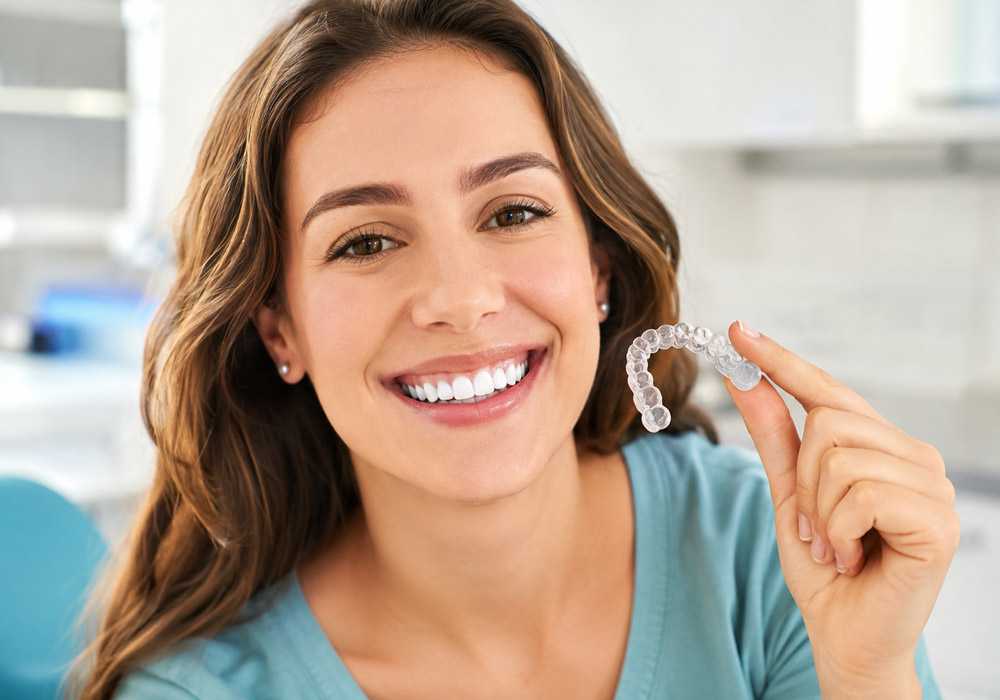
- What’s your daily routine like? Clear aligners are transparent, custom-molded plastic trays that apply gentle, controlled pressure to shift teeth over time. Unlike traditional metal braces, they’re virtually invisible, removable for eating and brushing, and far more comfortable.
- Do you drink coffee or tea regularly? If so, Spark’s TruGEN material may be worth asking your orthodontist about specifically.
- What does your insurance cover? Invisalign’s extensive insurance acceptance and financing options make it accessible for many families, but other systems may qualify under your plan as well. Always confirm with your provider before assuming coverage.
What separates in-office aligners from DIY mail-order options is that your trays are designed specifically for your teeth, your bite, and your goals. Direct-to-consumer kits skip the orthodontist entirely, along with the expertise that keeps your teeth, roots, and jaw healthy throughout the process. The American Association of Orthodontists has raised concerns about unsupervised aligner use for good reason.
Bottom Line
Every system on this list delivers genuine, clinically supervised results when prescribed and monitored by a qualified orthodontist. Invisalign carries the deepest case history and the widest provider access. Spark wins on clarity and stain resistance. ClearCorrect keeps costs more manageable for straightforward cases. SureSmile leans on digital integration. 3M Clarity brings decades of material expertise. And Angel Aligner rounds out the list with surprising capability for complex movements.
Your job before committing to any of them is to book a consultation with a certified orthodontic specialist, get a 3D scan done, and ask directly which system your provider uses most. The brand matters, but the hands guiding your treatment matter more.
For more detailed guidance on what your first orthodontic consultation looks like and what questions to ask, the American Association of Orthodontists maintains a reliable patient resource library worth bookmarking.