
Introduction
When a tragic death occurs, the question of accountability often arises. While many unfortunate incidents are deemed civil matters or accidents, some cross a critical line into the realm of criminal law. This is where the concept of gross negligence in criminal law becomes profoundly important, carrying severe consequences for individuals whose actions or inactions lead to a fatality.
We understand that navigating the complexities of criminal culpability can be challenging. Unlike ordinary negligence, which typically results in civil liability, gross negligence requires a significantly higher degree of blameworthiness—conduct so egregious that it warrants state-imposed criminal sanctions. It represents a marked departure from the standard of care expected of a reasonable person, creating a serious and obvious risk of death.
In this comprehensive guide, we will explore what defines gross negligence manslaughter and how it is distinguished from other forms of negligence and recklessness. We will delve into the essential legal elements that must be proven, examine the objective tests applied by courts, and discuss how causation is established, particularly in high-stakes environments like medical or workplace settings. Understanding this intricate area of law is crucial, especially for those seeking clarity on the rigorous standards applied in what is often referred to as Board-Certified gross negligence law. Join us as we shed light on this critical aspect of our justice system.
The Legal Framework of Gross Negligence Manslaughter
Gross negligence manslaughter stands as a serious common law offense in England and Wales, where a death results from a breach of duty that is so exceptionally bad it merits criminal punishment. This form of involuntary manslaughter arises when an individual, lacking the direct intent to kill, causes death through a profoundly negligent act or omission. The legal framework is designed to differentiate between a mere mistake or civil wrong and conduct that is so reprehensible it demands the full force of the criminal justice system.
At its core, establishing gross negligence manslaughter involves proving a clear duty of care owed by the defendant to the deceased, a severe breach of that duty, and a direct causal link between the breach and the death. The severity of the breach is paramount; it must be so egregious as to be deemed “gross” by a jury. This standard is not easily met, reflecting the high bar for criminal culpability in cases without intent. The seminal case of R v Adomako (1994) laid down the modern test for this offense, solidifying the elements required for a conviction.
The concept of a duty of care is fundamental. It can arise from pre-existing relationships, such as doctor-patient or employer-employee, or be established through specific legal tests like the Caparo test, which considers foreseeability, proximity, and fairness. Once a duty is established, the prosecution must demonstrate that the defendant’s actions or inactions fell significantly below the expected standard, directly contributing to the fatality. This rigorous legal framework ensures that only the most severe cases of negligence are elevated to the level of criminal sanction.

The Five Essential Elements of Criminal Liability
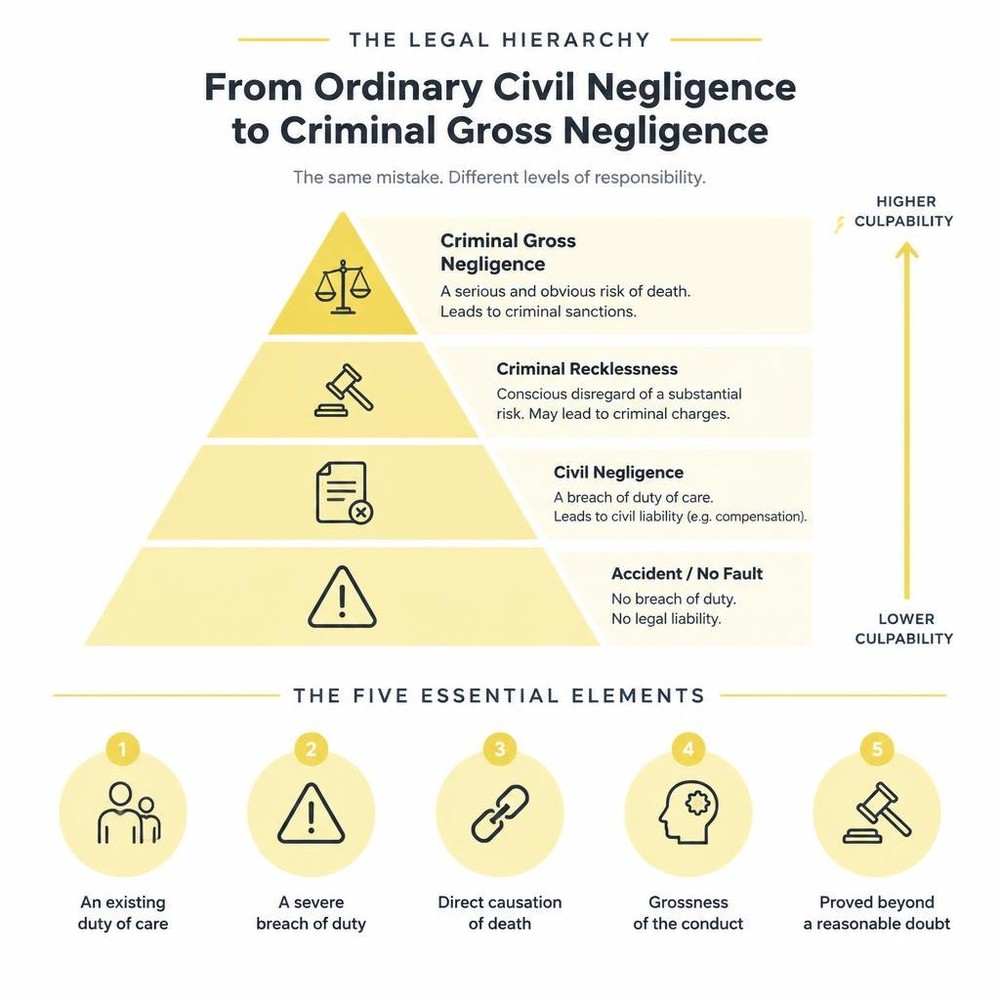
To secure a conviction for gross negligence manslaughter, the prosecution must meticulously prove five distinct elements beyond a reasonable doubt. These elements form the bedrock of the legal test, ensuring that the gravity of the charge is matched by the robustness of the evidence.
- An Existing Duty of Care: The defendant must have owed a duty of care to the deceased. This duty can arise in various contexts, including professional relationships (e.g., medical professionals to patients, employers to employees), contractual obligations, or even voluntarily assumed responsibilities. The law imposes a duty to act reasonably to prevent harm to those who might be affected by one’s actions or omissions.
- A Breach of That Duty: The defendant must have breached this established duty of care. This means their conduct fell below the standard expected of a reasonable person in their position, or, in professional contexts, below the standard of a reasonably competent professional. The breach must be clearly demonstrable through evidence.
- Causation of Death: The breach of duty must be proven to have caused the death of the victim. This involves both factual causation (the “but for” test – but for the defendant’s breach, would the death have occurred?) and legal causation (the breach must be a significant and operative cause of death, not merely a minor contributor).
- A Serious and Obvious Risk of Death: At the time of the breach, there must have been a serious and obvious risk of death to the deceased. This is a crucial element that distinguishes criminal gross negligence from mere civil negligence. The risk must be apparent to a reasonable person at the time the breach occurred, not in hindsight. It refers specifically to a risk of death, not merely injury or serious harm.
- The Breach Was So Bad as to Be Criminally Gross: This is the qualitative element, often considered the most challenging to prove. The negligence must be truly “gross” – so exceptionally bad and reprehensible in all the circumstances as to amount to a criminal act or omission. It goes beyond mere carelessness or incompetence and demonstrates such a disregard for the life and safety of others that it warrants criminal punishment.
Each of these elements must be established for a conviction, underscoring the high threshold for gross negligence manslaughter.
The Objective Legal Standard in Gross Negligence Law
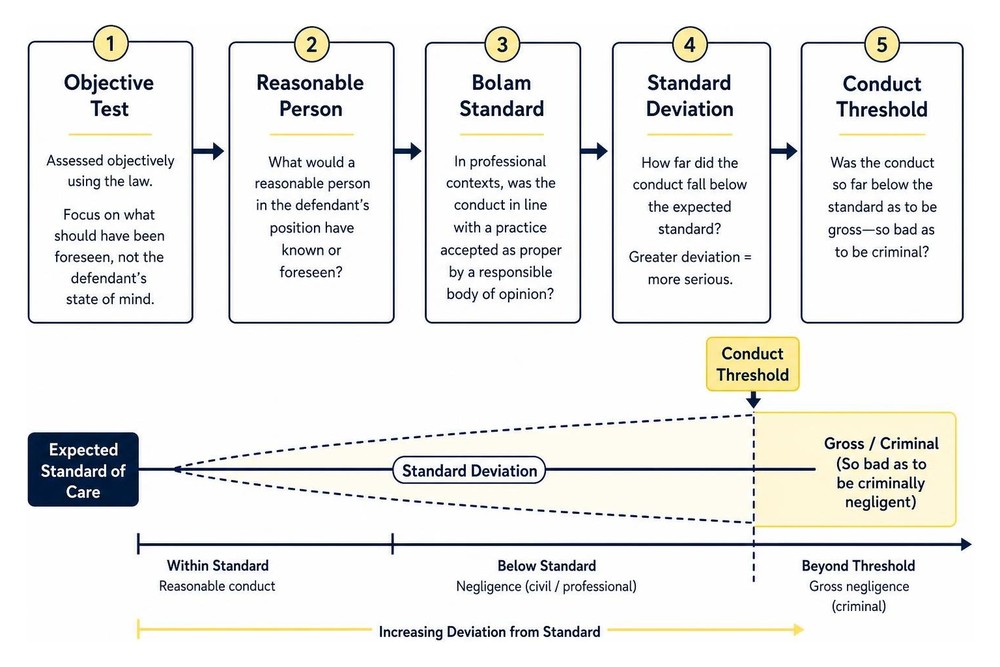
The determination of whether a breach of duty is “gross” enough to warrant criminal liability is assessed using an objective legal standard. This means the court considers what a reasonable person, in the defendant’s position, would have known or foreseen, rather than focusing solely on the defendant’s subjective state of mind. The question is whether the defendant’s conduct was so far below the standard of care that it should be judged criminal.
In professional contexts, the “Bolam standard” often plays a role in establishing the standard of care, asking whether the professional acted in accordance with a practice accepted as proper by a responsible body of medical opinion. However, while expert evidence helps define the expected standard and whether it was breached, the ultimate decision on whether the breach was “gross” and therefore criminal rests with the jury. They must decide if the conduct was so exceptionally bad as to justify a criminal conviction, rather than simply being a civil wrong or professional misconduct. This objective test ensures consistency and prevents defendants from escaping liability simply by claiming they were unaware of the risks, as long as a reasonable person would have perceived them. Understanding these intricate objective standards is fundamental for anyone navigating complex criminal negligence cases.
Foreseeability and the Serious and Obvious Risk of Death
A cornerstone of gross negligence manslaughter is the requirement that there was a “serious and obvious risk of death” at the time of the breach of duty. This element was particularly highlighted in the case of R v Rose (2017), which clarified that the risk must be both serious and obvious, and crucially, it must be a risk of death, not just serious injury.
The assessment of this risk is prospective, meaning it is judged based on the knowledge and information available to the defendant at the time of the negligent act or omission, not with the benefit of hindsight. It asks whether a reasonably prudent person, in the defendant’s shoes, would have foreseen a serious and obvious risk of death arising from their actions or inactions. If the risk of death was merely a possibility, or if it only became apparent after the event, this element would not be satisfied.
This stringent requirement serves as a vital gatekeeper, ensuring that only cases where the fatal risk was clearly apparent and serious are considered for criminal prosecution. It distinguishes between situations where a death was an unforeseen tragedy and those where it was the foreseeable, albeit unintended, consequence of profoundly negligent conduct. The temporal evaluation of risk is critical: the obviousness of the risk must exist at the very moment the breach occurred, making the defendant’s conduct particularly blameworthy for failing to address such a patent danger.
Understanding the Spectrum of Liability and Gross Negligence Law
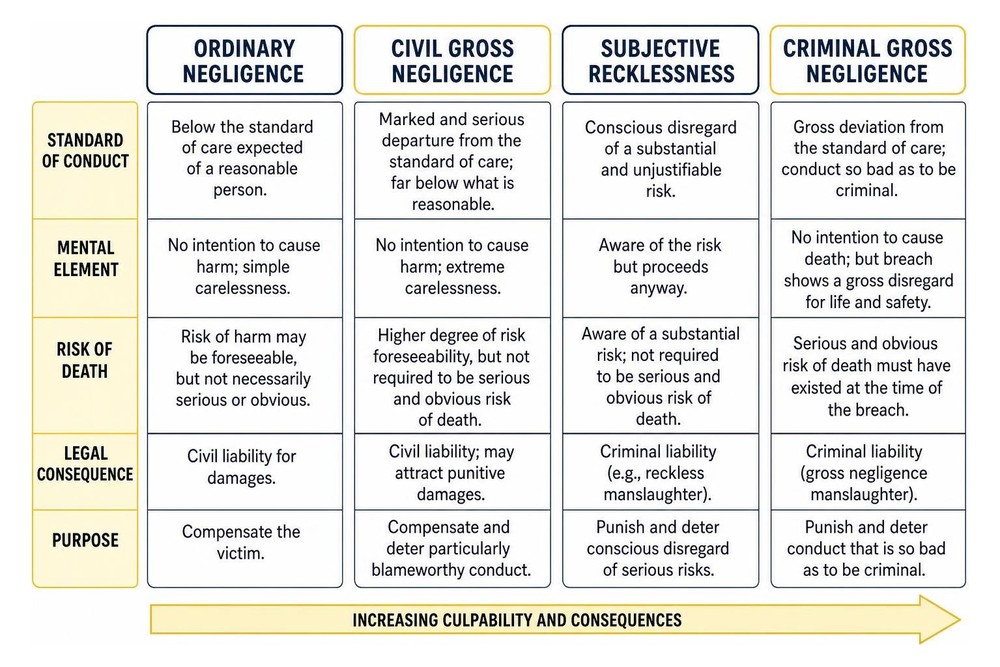
The concept of negligence exists on a spectrum, with varying degrees of culpability and legal consequences. At one end, we have ordinary civil negligence, which typically leads to financial compensation for damages. As the degree of carelessness increases, we move towards civil gross negligence, which might attract punitive damages in some jurisdictions. However, crossing the threshold into criminal gross negligence, particularly in cases of manslaughter, signifies a profound shift in legal and societal judgment, moving from compensation to punishment.
Criminal gross negligence involves a “gross deviation” from the standard of care, often described as “wanton” conduct or a complete disregard for safety. Unlike civil torts, which aim to restore the injured party to their original position, criminal statutes focus on societal condemnation and the imposition of state-sanctioned penalties, including imprisonment. The legal system carefully delineates these categories, recognizing that not all harmful mistakes warrant criminal charges. The distinction hinges on the severity of the departure from expected standards and the foreseeability of grave outcomes.
Distinguishing Criminal Culpability from Civil Negligence Under Gross Negligence Law
The line between civil negligence and criminal culpability, particularly for gross negligence manslaughter, is one of the most critical distinctions in law. While both involve a failure to meet a standard of care, their purposes, burdens of proof, and consequences differ dramatically.
Civil negligence, often heard in personal injury lawsuits, requires proof on the “preponderance of the evidence” – meaning it’s more likely than not that negligence occurred and caused harm. The primary goal is financial compensation for the victim. Historically, English courts have expressed skepticism about “gross negligence” as a distinct civil concept, sometimes referring to it as merely ordinary negligence with a “vituperative epithet” – an insulting adjective. This perspective suggests that in civil law, negligence is negligence, and the degree might only affect the quantum of damages, not the fundamental nature of the wrong.
In contrast, criminal gross negligence manslaughter demands a much higher standard of proof: “beyond a reasonable doubt.” This reflects the severe consequences, which include custodial penalties and a criminal record. The conduct must be so exceptionally bad, demonstrating such a disregard for life, that it warrants state punishment. It’s not about making the victim whole financially, but about holding the defendant accountable to society for a profound breach of duty leading to death. Therefore, while a single act might trigger both civil and criminal proceedings, the legal tests, evidentiary requirements, and ultimate outcomes for navigating criminal negligence claims are fundamentally distinct.
Subjective Recklessness Versus Objective Gross Negligence
The distinction between subjective recklessness and objective gross negligence is crucial in criminal law, particularly when assessing a defendant’s state of mind. While both can lead to criminal liability, they represent different forms of culpability.
Subjective Recklessness: This involves the defendant consciously appreciating a substantial and unjustifiable risk and then deliberately taking that risk. The Cunningham test, a cornerstone of English criminal law, requires proof that the defendant foresaw the risk of harm but went on to take it anyway. Here, the defendant’s actual state of mind and awareness of the danger are paramount. For example, if someone knowingly drives at excessive speed through a crowded area, aware of the risk of hitting someone but deciding to do so anyway, that could be considered reckless.
Objective Gross Negligence: In contrast, gross negligence manslaughter is primarily an objective test. The defendant does not necessarily need to have subjectively appreciated the serious and obvious risk of death. Instead, the focus is on whether a reasonable person, in the defendant’s position, would have foreseen such a risk. The blameworthiness arises from the defendant’s failure to perceive a risk that was objectively obvious and serious, and their subsequent conduct falling so far below the expected standard that it is deemed criminal. While the defendant’s state of mind might be considered in assessing the “grossness” of their conduct, it is not a prerequisite for liability in the same way it is for recklessness. The core difference lies in conscious disregard versus an egregious, blameworthy failure to perceive and act upon an obvious danger.
High-Risk Operational Contexts and Causation in Criminal Omissions
Gross negligence manslaughter often arises in high-risk operational contexts where individuals hold significant responsibilities for the safety and well-being of others. In these scenarios, liability can stem not only from active misconduct but also from criminal omissions – a failure to act when there was a legal duty to do so. The law recognizes that a duty of care can arise in various ways, including through a pre-existing relationship, the creation of a dangerous situation, or the voluntary assumption of care.
For instance, if an individual creates a dangerous situation, they may acquire a duty to take reasonable steps to counteract that danger, as illustrated in R v Miller. Similarly, those who voluntarily assume responsibility for another’s care, particularly vulnerable individuals, can be held liable for omissions if their neglect leads to death, as seen in cases like R v Stone and Dobinson. Custodial duties, such as those held by police or prison officers, also impose a high standard of care, where a failure to provide necessary assistance to a person in custody leading to their death can result in gross negligence manslaughter charges. Establishing causation in these omission cases can be complex, requiring proof that the failure to act was a significant factor in the death.

Medical Manslaughter and Clinical Decision-Making
Medical manslaughter, a specific application of gross negligence manslaughter, is one of the most scrutinized areas due to the inherent trust placed in healthcare professionals and the life-or-death nature of their work. While medical errors are unfortunately common, only a tiny fraction ever cross the threshold into criminal liability. This is because the law recognizes the complexities of clinical decision-making, systemic pressures, and the reality that mistakes can occur even with the best intentions.
Cases often involve critical diagnostic errors, incorrect drug administration, or failures to follow established clinical protocols. However, the legal standard requires more than a simple lapse in judgment; it demands a “gross” deviation from the expected standard of care, creating a serious and obvious risk of death. Expert evidence plays a crucial role in determining whether a doctor’s conduct fell so far below that of a reasonably competent practitioner as to be deemed criminal.
There’s an ongoing debate about the impact of criminal prosecutions on patient safety. Some argue that individual blame undermines a “just culture” where errors are reported and learned from, advocating instead for systemic fixes and human factors engineering to improve safety. Others maintain that criminal sanctions are necessary to uphold accountability for truly egregious conduct. Recent cases, such as the Bombay High Court’s ruling on Section 304-A IPC, underscore the high threshold for criminal negligence against medical professionals, emphasizing that mere error or lack of care is insufficient for criminal liability; gross negligence or recklessness must be proven.
Workplace Fatalities, Safety Violations, and Custodial Neglect
Beyond medical settings, gross negligence manslaughter charges frequently arise in contexts involving workplace fatalities, severe safety violations, and instances of custodial neglect. These environments inherently carry responsibilities for the safety of others, and a gross breach of these duties can have fatal consequences.
In the workplace, employers and managers have a duty to ensure a safe working environment. This includes maintaining equipment, implementing safety protocols, and providing adequate supervision and training. When an employer or a responsible individual consciously ignores safety warnings, operates dangerous machinery against regulations, or makes decisions that recklessly endanger workers, and this leads to a death, gross negligence manslaughter charges may be considered. Examples include a worker falling from a height due to unsafe equipment, or an industrial accident caused by operating machinery against safety protocols.
Similarly, individuals or institutions responsible for persons in custody – such as police, prison officers, or care home staff – owe a high duty of care. A failure to provide essential care, supervision, or medical assistance to a vulnerable detainee or resident, leading to their death, can constitute gross negligence manslaughter. These cases often highlight gross omissions and a profound disregard for detainee welfare. In all these scenarios, the prosecution must demonstrate a clear duty, a gross breach, causation of death, and a serious and obvious risk of death at the time of the breach.
Individual Gross Negligence Manslaughter Versus Corporate Manslaughter
It is essential to distinguish between individual gross negligence manslaughter and corporate manslaughter, as they address different forms of accountability following a death.
Individual Gross Negligence Manslaughter focuses on the culpability of an individual. As discussed, it requires proving the five elements against a specific person whose actions or inactions were so exceptionally bad as to cause death. The consequences for a conviction are severe, including potential imprisonment.
Corporate Manslaughter, introduced in the UK by the Corporate Manslaughter and Corporate Homicide Act 2007, targets the liability of organizations. This offense applies where a death is caused by a gross breach of a relevant duty of care owed by an organization, and the way in which its activities are managed or organized by its senior management is a substantial element in the breach. Unlike individual gross negligence manslaughter, it does not require proving that a specific individual’s gross negligence caused the death. Instead, it looks at systemic failures and the role of senior management in those failures.
Key differences include:
- Target of Liability: Individual vs. Organization.
- Proof of Risk: Corporate manslaughter does not require proving a serious and obvious risk of death; it focuses on a gross breach in management systems.
- Consequences: Individuals face imprisonment; organizations face unlimited fines, remedial orders (requiring steps to remedy the breach), and publicity orders (requiring public announcement of conviction).
- Focus: Individual blameworthiness vs. organizational culture and systemic failures overseen by senior management.
While an organization can be convicted of corporate manslaughter, individuals within that organization can still face separate prosecution for gross negligence manslaughter if their personal conduct meets the required threshold.
Sentencing Guidelines, Criminal Sanctions, and Legal Defenses
A conviction for gross negligence manslaughter carries profound legal consequences, often resulting in significant custodial sentences. The sentencing framework aims to reflect the culpability of the offender and the harm caused, while also considering various aggravating and mitigating factors.
Sentencing guidelines, such as those issued by the Sentencing Council in England and Wales, provide a structured approach to determining appropriate penalties. These guidelines categorize offenses based on culpability (ranging from high to lower) and harm, leading to different starting points and ranges for imprisonment. Factors that might increase culpability include a high degree of foreseeability of harm, a prolonged course of negligent conduct, a failure to respond to warnings, or an attempt to conceal the negligence. Conversely, mitigating factors might include a momentary lapse of judgment (rather than persistent disregard), genuine remorse, good character, or the presence of systemic failures that contributed to the incident (though these do not negate individual liability).
Legal defenses often involve challenging one or more of the five essential elements, such as arguing that no duty of care existed, the breach was not “gross,” causation cannot be proven, or the risk of death was not serious and obvious at the time. The role of expert testimony is critical in presenting these arguments, as is the thorough examination of all available evidence.
Sentencing Thresholds and Mitigating Factors
The sentencing for gross negligence manslaughter is guided by the principle that the sentence should be proportionate to the offender’s culpability and the harm caused. While the maximum penalty can be life imprisonment, actual sentences vary widely depending on the specific circumstances of the case.
Culpability Ranges: The Sentencing Council’s guidelines typically define different levels of culpability:
- High Culpability: Characterized by a very high degree of negligence, disregard for a very high risk of death, or a prolonged period of neglect.
- Medium Culpability: Involves a significant degree of negligence, disregard for a significant risk, or a shorter period of neglect.
- Lower Culpability: Applies where the negligence is less severe, the risk is lower, or there are significant mitigating factors.
Aggravating Factors that can increase a sentence include:
- Failure to respond to warnings or advice.
- Concealment of the negligent act.
- Exploitation of a vulnerable victim.
- Offending while under the influence of alcohol or drugs.
- Previous convictions for similar offenses.
Mitigating Factors that can reduce a sentence include:
- A momentary lapse of judgment rather than a prolonged course of conduct.
- Genuine remorse and efforts to make amends.
- Good character and lack of previous convictions.
- The existence of systemic failures or organizational pressures that contributed to the incident, reducing the individual’s sole blameworthiness.
- The defendant’s physical or mental health.
The court carefully balances these factors to arrive at a just and proportionate sentence, aiming to reflect the gravity of the offense while considering the individual circumstances of the offender.
Evidentiary Burdens and Expert Witness Testimony
The prosecution in a gross negligence manslaughter case bears a heavy evidentiary burden, requiring proof beyond a reasonable doubt for each of the five elements. This often necessitates the extensive use of expert witness testimony, particularly in complex fields like medicine, engineering, or workplace safety.
Expert witnesses are crucial for:
- Establishing the Standard of Care: Experts define what a reasonably competent professional or individual would have done in the given circumstances.
- Identifying the Breach: They explain how the defendant’s actions or inactions fell below that standard.
- Proving Causation: Experts provide opinions on whether the breach was a significant contributory cause of death. This can be complex, especially if there were multiple contributing factors or pre-existing conditions. The “de minimis” rule in causation limits liability to cases where the death would not have been significantly delayed without the defendant’s actions.
- Assessing Risk and Foreseeability: Experts can help the jury understand the nature of the risk involved and whether it would have been serious and obvious to a reasonable person in that field.
However, it is vital to remember that while experts inform the jury on technical matters, they cannot dictate the ultimate finding of “criminality.” The jury, as the arbiter of fact, must independently decide whether the breach was so “gross” as to warrant criminal conviction, based on all the evidence presented. Clear jury directions from the judge are essential to ensure they apply the objective test correctly and do not simply defer to expert opinion on the ultimate legal question.
Frequently Asked Questions About Gross Negligence in Criminal Law
Navigating the nuances of gross negligence in criminal law can be challenging, given its distinct thresholds and applications compared to civil law. Here, we address some common questions to clarify this complex area, providing insights into understanding criminal negligence law more broadly.
What separates simple medical error from criminal gross negligence?
The key distinction lies in the severity and nature of the breach. A simple medical error, or ordinary medical negligence, involves a lapse in judgment or attention that causes harm, typically leading to civil liability. Criminal gross negligence, however, requires conduct that is so exceptionally bad and reprehensible that it demonstrates a profound disregard for the patient’s life and safety. It must involve a serious and obvious risk of death, objectively foreseeable at the time of the breach. Expert evaluation is crucial to determine if the conduct fell so far below the expected clinical judgment and professional standards as to cross this high criminal threshold.
Does an individual need subjective awareness of risk to be convicted?
No, not necessarily for gross negligence manslaughter. Unlike subjective recklessness, where the defendant must consciously appreciate and disregard a risk, gross negligence manslaughter operates primarily on an objective test. The prosecution must prove that a reasonable person, in the defendant’s position, would have foreseen a serious and obvious risk of death. While the defendant’s actual state of mind might be considered in assessing the “grossness” of their conduct, a lack of subjective awareness of the risk does not automatically serve as a valid legal defense if that risk was objectively obvious. The blameworthiness stems from the egregious failure to perceive and act upon an obvious danger that a reasonable person would have recognized.
How does gross negligence manslaughter differ from corporate manslaughter?
Gross negligence manslaughter concerns the criminal culpability of an individual, leading to potential imprisonment if convicted. It requires proving that a specific person’s exceptionally bad breach of duty caused a death where there was a serious and obvious risk of death.
Corporate manslaughter, conversely, applies to organizations. It focuses on systemic failures and the way an organization’s activities are managed or organized by its senior management, leading to a gross breach of duty that causes death. While the organization faces fines, remedial orders, and publicity orders, individuals within that organization can still be prosecuted for gross negligence manslaughter if their personal conduct meets the criteria. The key difference lies in the target of liability – an individual versus an entity – and the nature of the breach being assessed.
Conclusion
The concept of gross negligence in criminal law establishes a critical legal boundary, distinguishing between unfortunate accidents, civil wrongs, and conduct so profoundly negligent that it warrants criminal sanction. Gross negligence manslaughter, in particular, serves as a powerful mechanism for accountability when a death results from an exceptionally bad breach of duty, where a serious and obvious risk of death was objectively foreseeable.
We have explored the rigorous five-element framework, the objective legal standards applied, and the crucial role of foreseeability in establishing criminal culpability. From the complexities of medical manslaughter to the responsibilities inherent in workplace safety and custodial care, the application of these principles is both challenging and essential. Understanding the distinctions between ordinary negligence, civil gross negligence, subjective recklessness, and the high bar for criminal gross negligence is fundamental for anyone seeking to comprehend our justice system’s approach to such grave matters.
The ongoing dialogue around individual versus systemic accountability, particularly in high-risk environments, continues to shape criminal jurisprudence. The law strives to balance the need for individual responsibility with a recognition of complex operational realities, ensuring that only the most blameworthy conduct leading to death is met with the full force of criminal prosecution. This commitment to professional diligence and robust accountability standards remains a cornerstone of our legal framework.