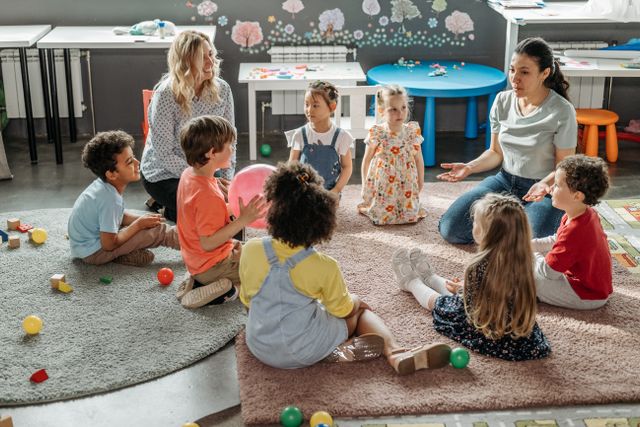
Early education starts shaping how you handle other people. Play is essential because it’s versatile. It allows children to experience scenarios that teach them about how life works. When they get to try out these scenarios, they essentially get to practice how to move through life and how to handle different people, be it a bully or someone impatient or stronger.
Routine And Feeling Safe In Groups
Routine in early education is offering bursts of predictability that help children relax into the day. When a child knows what usually comes next, they stop spending energy guessing. You don’t want a jittery child. That extra space in their mind gets used for noticing other people instead. They can actually listen, respond, and join in without feeling constantly unsettled.
You might not think routine connects to emotional skills, but it does in a very direct way. A stable rhythm teaches children that the world doesn’t randomly shift every five minutes. That sense of safety builds confidence in group settings. They start trusting that even if something is new, it won’t stay confusing forever.
Teachers As Emotional Anchors
In early education, teachers end up doing more than teaching colours or numbers. They’re there to act as emotional anchors when things go wrong. A child who is upset doesn’t need a lecture in most cases. However, they do need someone who can hold the moment steady. When you watch a good educator respond to frustration, you see calm behaviour being modelled in real time.
Children copy emotional tone before they understand emotional language. On top of that, children need someone to calmly respond to their big emotions. It shows them that emotions might be big, but they aren’t as scary. If a teacher stays steady when a child is overwhelmed, that steadiness starts to rub off. Over time, you get kids who don’t spiral as quickly when things go off track. When you explore childcare Balwyn North, go for centers that work on this kind of consistency, where emotional reactions are handled gently and without rush, and children slowly start to mirror that same stability back.
Small Conflicts That Teach Big Control
Children’s interactions are full of tiny clashes that look unimportant but do a lot of work underneath. Tension can escalate over the tiniest things. These moments are not cleaned up too quickly either. They are allowed to sit just long enough for children to try working through them. And yet, every minor conflict teaches them about self control and how to exercise it.
As a result, children learn that not every problem needs to turn into a meltdown. They learn that a meltdown can cost them energy and a bad mood. They test reactions and back off, and try a different approach instead. What comes out of this is emotional endurance. Over time, they stop treating discomfort as something urgent, and they no longer need to escape it as fast as possible.
Language Skills And Emotional Clarity
Early education gives children more words for what they are feeling. Once a child has more ways to express their concerns and big feelings, they change their approach to everything. A child who can say that they’re upset instead of screaming has already taken a step forward in emotional control. Of course, it doesn’t happen overnight, but for a young child, every step towards emotional control counts.
Language changes how children respond to others. Instead of just reacting, they begin to name what they think is happening. They might not get it right, but they are trying to translate emotion into words.
Friendships Formed In Structured Environments
Friendships in early education might not be something your child even remembers, but they are important training grounds for real social connection. Children learn how to start relationships without adult direction, which is harder than it looks. Just remember the last time you made a friend outside of work.
There is also something important about shared structure. When children spend time in the same environment regularly, friendships have space to form slowly instead of being rushed. They learn who they like being around, who they clash with, and how to adjust their behaviour without losing themselves completely.
Conclusion
It’s safe to say that early education ends up doing more than preparing children for schoolwork. The mix of play, structure, language, and everyday conflict gives them repeated chances to figure out how to respond instead of react. That matters later in life when situations stop being simple and start involving more emotion and responsibility.